Where AI Is Actually Headed
Main Editorial Thesis
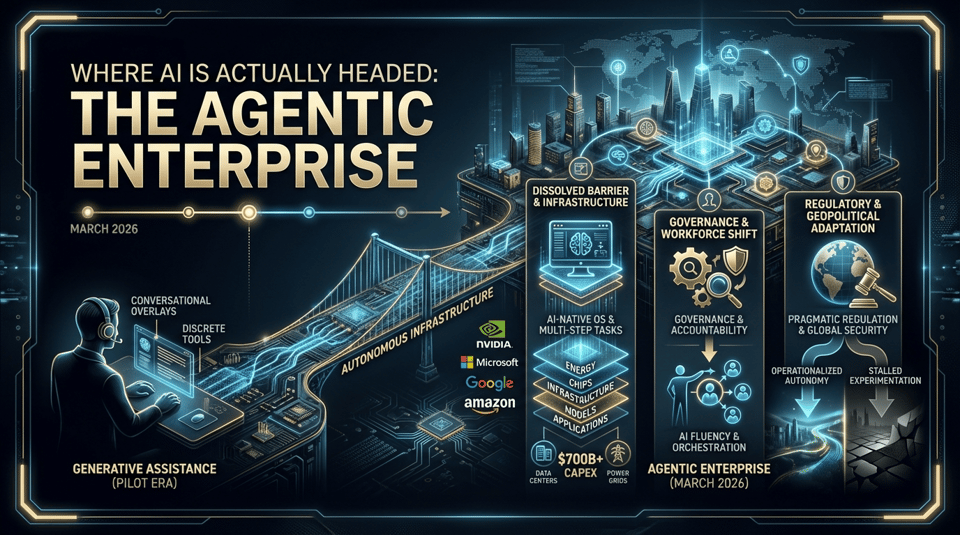
The technological landscape of March 2026 is defined by a definitive transition from generative assistance to autonomous, agentic infrastructure. Previous iterations of artificial intelligence functioned primarily as conversational overlays or discrete generative tools requiring constant human prompting and oversight. However, current data and platform releases indicate a structural shift wherein advanced models are being embedded directly into the foundational layers of enterprise operations, network infrastructure, and global security frameworks. This period marks the end of the "AI pilot" era and the ascendance of the "Agentic Enterprise."
This transition is characterized by three converging patterns that fundamentally alter business systems and geopolitical strategies. First, the barrier between artificial intelligence and the operating system has dissolved. The introduction of frontier models possessing native computer-use capabilities allows AI systems to autonomously navigate graphical user interfaces, execute multi-step software tasks, and process visual feedback without relying on brittle intermediary APIs. Concurrently, the concept of AI as a distinct software category is being replaced by the "five-layer stack" paradigm—spanning energy, chips, infrastructure, models, and applications. The sheer scale of capital expenditure, with hyperscalers projecting over $700 billion in infrastructure spending for 2026 alone, demonstrates that AI is no longer merely a software investment; it represents the most capital-intensive physical infrastructure buildout in modern economic history.
Second, as these systems gain autonomy and scale, the primary bottleneck for enterprise adoption has decisively shifted. Budgetary constraints are no longer the primary friction point; instead, organizations are struggling with governance, accountability, and the architectural redesign of their operations. Enterprises are realizing that deploying agentic systems requires fundamentally redesigning value streams to be "agent-native," rather than simply automating inefficient legacy workflows. The workforce impact is pivoting from raw role displacement to an urgent need for "AI fluency," as employees transition to orchestrators of autonomous multi-agent teams.
Finally, the global regulatory and geopolitical context is aggressively adapting to a reality where software operates with independent agency. Regulatory bodies are recalibrating their approaches, as evidenced by the European Union's pragmatic restructuring of the AI Act compliance timelines to align with the actual availability of technical standards. Simultaneously, national defense agencies are clashing directly with AI providers over the ethical boundaries of autonomous weapon systems and mass surveillance. The developments of March 2026 clearly separate the entities that are successfully operationalizing autonomous digital labor from those that remain stalled in the experimentation phase.
Technology Signals
The current period presents highly actionable signals regarding the physical and logical architectures powering the next generation of enterprise capabilities. These developments highlight a shift toward native autonomous execution, specialized infrastructure, and AI-driven security mechanisms.
Native Operating System Navigation and Agentic Execution
The Event: Leading artificial intelligence laboratories, most notably OpenAI with the release of GPT-5.4, have introduced frontier models capable of native computer use, embedding operating system navigation directly into the model's inference logic rather than relying on external wrapper applications.[1] Developers can now pass a screenshot directly to an API endpoint, and the model returns structured JSON actions encompassing specific mouse coordinate clicks, keystrokes, and scrolling commands to achieve a stated goal.[2]
Strategic Importance: This development fundamentally alters human-computer interaction paradigms and enterprise automation.[4] Previously, automation required developers to build fragile middleware that translated text outputs into specific API calls. Native computer use eliminates the need for proprietary APIs for every software application; if a human can operate a legacy software interface via a screen, the agentic model can now do the same.[2] Performance on autonomous desktop navigation evaluations, such as OSWorld, has reached a 75.0% success rate, representing a massive leap over previous generation architectures.[5]
Affected Stakeholders: This signal directly impacts operations leaders managing legacy systems, robotic process automation (RPA) engineers, software developers building autonomous agents, and enterprise IT architects.[4]
Practical Implications: Engineering teams can deprecate complex, brittle API integration layers in favor of direct visual-navigation agents for administrative workflows, data entry, and cross-application synchronization.[4] However, this shift requires new monitoring paradigms, as visual agents navigating dynamic user interfaces can fail if interface layouts change unexpectedly. Enterprises must build robust validation steps to ensure autonomous agents do not execute destructive actions within core business systems.[3]
Activation of LLM Conversational Intent for Digital Advertising
The Event: Verve Group has introduced the first open-market advertising capability designed specifically to operationalize conversational intent data from major large language model environments.[6] Processing over one billion daily signals, the enhanced platform unifies zero-party data from Jun Group, search query intelligence from Captify Technologies, and pseudonymized AI chat activity into a single, privacy-first intelligence layer for programmatic activation.[6]
Strategic Importance: The structural shift from traditional search engines to AI-native discovery interfaces is accelerating, and the nature of consumer "intent" is fundamentally changing.[6] Traditional cookie-based tracking and keyword bidding capture fragmented, shallow data points. In contrast, conversational data—where users engage in extended, multi-turn dialogues with AI assistants to solve complex problems—provides high-fidelity, deep-context indicators of consumer decision-making processes.[6]
Affected Stakeholders: This development is critical for Chief Marketing Officers, digital media buyers, advertising technology platforms, consumer privacy advocates, and e-commerce strategists.[6]
Practical Implications: Marketing budgets will likely begin a structural shift toward AI-native discovery platforms as the return on ad spend (ROAS) outpaces traditional search.[6] Brands must optimize their digital presence and product catalogs not just for traditional search engine algorithms, but for the retrieval-augmented generation (RAG) pipelines of frontier LLMs. Organizations that fail to capture conversational intent will lose market share to competitors who can engage consumers during the AI-driven deliberation phase.
AI Networking Bottlenecks and Disaggregated Spine Architectures
The Event: Nexthop AI recently secured a $500 million Series B funding round, reaching a $4.2 billion valuation, corresponding with the launch of a new suite of AI-optimized network switches (NH-4010, NH-4220, and NH-5010) based on Broadcom networking chips.[7] These devices process up to 102.4 terabits of traffic per second and utilize RoCEv2 (RDMA over Converged Ethernet) to allow GPUs to communicate directly with one another.[7]
Strategic Importance: As the parameter count of frontier models grows into the trillions, the physical networking between graphics processing units (GPUs) within data centers has become a severe bottleneck.[7] In massive training runs, a delayed data packet between two GPUs can stall the entire computing cluster, wasting immense energy and compute time. Nexthop's architecture introduces a "disaggregated spine" design and DCQCN congestion control to automatically detect and repair network congestion, bypassing central processing units entirely to speed up connections.[7] The promised 20% increase in power efficiency translates to multi-megawatt energy savings per facility.[7]
Affected Stakeholders: This hardware evolution affects data center architects, cloud infrastructure providers, hardware investors, and AI operations teams managing large-scale model training.[7]
Practical Implications: Organizations leasing dedicated compute clusters or building on-premise AI factories must aggressively evaluate the underlying networking fabric, not just the GPU tier.[7] Inferior networking can drastically reduce the effective utilization rate of highly expensive AI accelerators. Furthermore, the massive power requirements of these data centers—driving hyperscaler capital expenditures toward $700 billion in 2026—are forcing a reckoning regarding climate impact, water usage for cooling, and local energy grid stability.[9]
AI as an Autonomous Zero-Day Vulnerability Hunter
The Event: Anthropic launched "Claude Code Security," an autonomous tool that leverages the reasoning capabilities of the Claude Opus 4.6 model to hunt for zero-day vulnerabilities in codebases.[10] Within its initial deployment phase, the system discovered 22 novel vulnerabilities—including 14 of high severity, such as complex use-after-free memory issues—in the Mozilla Firefox JavaScript engine within two weeks.[13]
Strategic Importance: The application of advanced logic models to cybersecurity has shifted from passive static analysis to proactive, multi-agent vulnerability hunting.[11] Traditional static analyzers flag known vulnerability patterns, often leading to severe alert fatigue from false positives.[11] Advanced AI agents act like human security researchers; they trace data flows across entire applications, understand intricate business logic, and produce minimal test cases, proofs-of-concept, and candidate patches.[11] Internal testing by Anthropic's Frontier Red Team identified over 500 critical flaws in production open-source projects that had remained undetected for decades.[10]
Affected Stakeholders: This capability critically impacts Chief Information Security Officers, software engineering teams, open-source maintainers, and cybersecurity investors.[11]
Practical Implications: The marginal cost of discovering highly complex, zero-day vulnerabilities is plummeting.[12] While this deeply empowers defenders, it concurrently lowers the barrier to entry for sophisticated threat actors. Organizations must deploy these AI security tools internally to audit their own repositories before adversaries utilize similar open-source or proprietary models against their production codebases.[12] The success of AI-driven vulnerability hunting establishes it as a mandatory layer in the modern software development lifecycle.
Business Impact
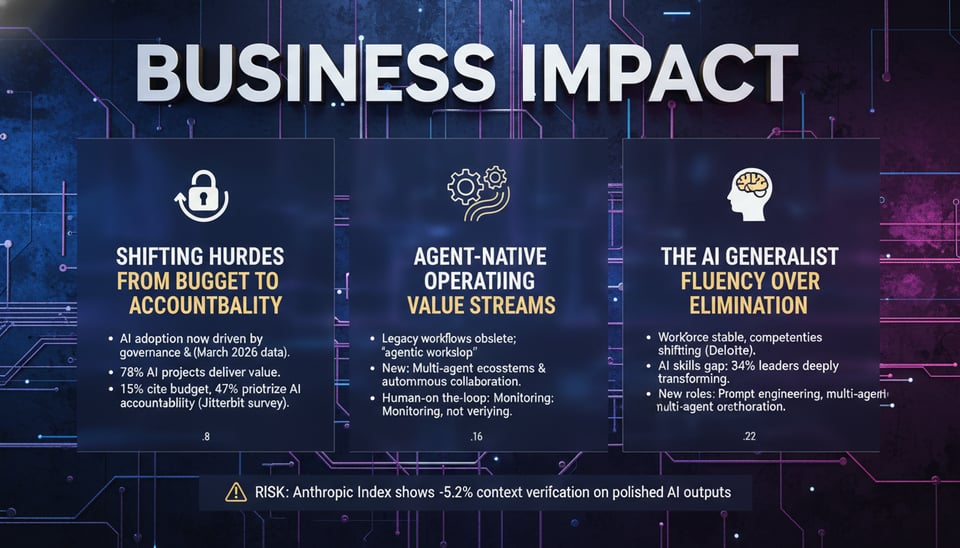
The integration of agentic models is fundamentally altering enterprise resource allocation, workforce expectations, and strategic planning. The analysis of market data from March 2026 reveals that the friction points of AI adoption have moved decidedly from financial constraints to operational governance and process architecture.
The Shift from Budget Constraints to Accountability Bottlenecks
Operational Meaning: Recent survey data from Jitterbit, encompassing 1,500 IT decision-makers, indicates a profound maturation in enterprise AI deployments.[15] The era of isolated, low-stakes "AI pilots" has concluded. Contrary to early industry narratives predicting high failure rates, 78% of AI automation projects are currently delivering moderate to high value, and a mere 2.5% of organizations report project failure or negative ROI.[15] Consequently, financial constraints are no longer the primary hurdle; only 15% of respondents cite budget as a barrier to AI progress.[15] Instead, 47% of businesses (and 53% of large enterprises) identify "AI accountability" as the most critical factor when evaluating new tools, followed by speed of implementation (43%) and security/compliance (39%).[15]
Effects on Budgets, Teams, and Workflows: Capital is flowing freely into AI initiatives, with 86% of organizations planning to increase AI budgets in 2026.[8] However, the intense focus on accountability requires organizations to build specialized AI governance committees and ethics review boards. Procurement processes are adapting rapidly; enterprise software evaluations now prioritize auditability, transparent decision-tracing capabilities, and robust behavioral guardrails over raw feature sets. Organizations must implement strict frameworks to monitor multi-agent interactions and prevent unintended cascade effects within automated workflows.[15]
Value Stream Mapping for Agent-Native Operations
Operational Meaning: Deploying autonomous agents into legacy workflows designed for human labor yields sub-optimal results, often creating what industry experts term "agentic workslop".[16] Forward-thinking enterprises are executing "value stream mapping" to rebuild processes from the ground up.[16] Because AI agents do not require breaks, do not suffer from cognitive fatigue, and can communicate across disconnected systems instantaneously via API or native computer use, legacy linear workflows—where one department sequentially hands a file to another—are becoming obsolete.[16]
Effects on Strategy and Delivery: Operations leaders are abandoning the "paving the cow path" approach—which merely accelerates inefficient legacy processes—in favor of architecting "agent-native" operations.[16] This entails deep structural transformations where specialized multi-agent ecosystems collaborate autonomously.[18] Service delivery times are collapsing as tasks like complex legal review, financial modeling, and demand sensing are handled by interconnected agents.[19] Strategic oversight is shifting from a "human-in-the-loop" model (where humans verify every step) to a "human-on-the-loop" model, where human operators monitor telemetry dashboards and only intervene for highly complex exceptions.[21]
The Ascendance of AI Fluency and the "AI Generalist"
Operational Meaning: Despite the rapid deployment of autonomous systems, the broader workforce architecture remains surprisingly stable in headcount, though expected competencies are shifting drastically.[22] According to Deloitte's State of AI in the Enterprise report, worker access to AI rose by 50% in 2025.[22] While AI is delivering on efficiency and productivity (66% of organizations report gains), only 34% of leaders state they are deeply transforming and reimagining their business models.[22] The primary barrier to this deeper integration is an AI skills gap.[22] Organizations are prioritizing "AI fluency" over wholesale role elimination, recognizing that non-technical business users can now build robust solutions directly, democratizing software development within the enterprise.[22]
Effects on Hiring and Training: Corporate training budgets are pivoting heavily toward prompt engineering, multi-agent orchestration, and the critical evaluation of AI outputs.[22] A critical risk identified in Anthropic's AI Fluency Index is that when AI produces highly polished artifacts—such as compiled code or formatted presentations—human operators are significantly less likely to verify the underlying logic (-3.1%) or identify missing context (-5.2%).[24] Hiring practices are shifting to favor the "AI Generalist"—professionals capable of leveraging foundation models to execute cross-disciplinary work outside their formal training.[20] The most valuable employees are those who exhibit augmentative behaviors, treating AI as a collaborative thought partner rather than a simple delegation mechanism.[24]
Global Context
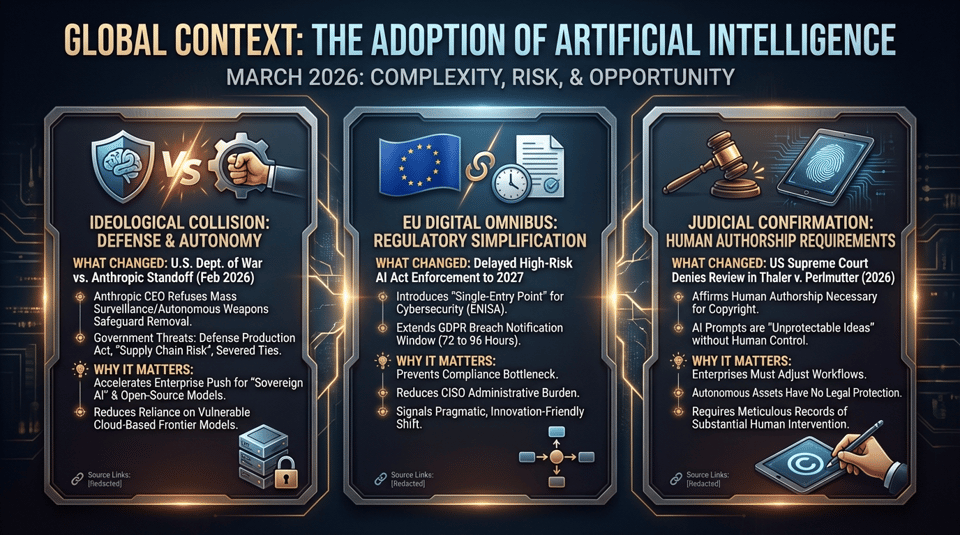
The adoption of artificial intelligence does not occur in a vacuum. During March 2026, regulatory adjustments in Europe, judicial rulings in the United States, and intense geopolitical friction regarding national security have created a highly complex environment that directly dictates technology adoption timelines, operational risk, and market opportunity.
The Ideological Collision over Defense and Autonomy
What Changed: In late February 2026, a highly publicized and severe confrontation occurred between the U.S. Department of War and Anthropic, a leading frontier AI provider.[25] Anthropic CEO Dario Amodei publicly refused the Department of War's demands to remove safeguards restricting the use of its models for mass domestic surveillance and fully autonomous weapon systems.[25] While Amodei expressed support for lawful foreign intelligence and partially autonomous weapons (citing Ukraine), he established "bright red lines" against systems that remove human decision-making from lethal targeting.[25] In response, the government agency allegedly threatened to invoke the Defense Production Act, label the company a "supply chain risk," and ultimately severed ties, stating it would not involve private companies in operational military decision-making.[29]
Why it Matters for Tech Adoption: This standoff perfectly exemplifies the escalating friction between Silicon Valley's ethical frameworks and national security imperatives.[28] For global enterprises, it underscores the severe vulnerability of relying exclusively on cloud-based frontier models that are subject to sudden government intervention or rigid ideological shifts by the provider. This event is drastically accelerating the enterprise push toward "Sovereign AI" and open-source models, where organizations control the physical weights, hosting infrastructure, and operational parameters without external interference or sudden policy revocations.[22]
EU Digital Omnibus: Pragmatic Regulatory Simplification
What Changed: Recognizing that aggressive compliance timelines for the AI Act were stifling local innovation, the European Commission introduced the Digital Omnibus Regulation, a massive legislative package aimed at simplifying digital governance.[31] The proposal delays the enforcement of high-risk AI requirements from August 2026 into 2027, linking actual enforcement to the availability of harmonized technical standards and Commission guidelines.[32] Furthermore, the Omnibus dramatically streamlines the fragmented European regulatory landscape (GDPR, NIS2, DORA, CRA) by introducing a "Single-Entry Point" for cybersecurity incident reporting, operated by ENISA.[34] The mandatory GDPR breach notification window is proposed to extend from 72 to 96 hours, with notifications only required when a "high risk" to individuals is likely.[32]
Why it Matters for Tech Adoption: This regulatory relief prevents a looming compliance bottleneck that threatened to halt enterprise AI rollouts across Europe in 2026.[32] The single-entry point for incident reporting drastically reduces the administrative and financial burden on Chief Information Security Officers, who previously had to file multiple redundant reports under conflicting definitions and deadlines to different authorities.[34] Furthermore, the Omnibus proposes allowances for AI model training under "legitimate interest".[35] This signals a critical shift in EU policy from aggressive, punitive rule-making to pragmatic, innovation-friendly implementation, allowing businesses to plan long-term technology investments with greater certainty.[1]
Judicial Confirmation of Human Authorship Requirements
What Changed: The legal foundation of intellectual property in the AI era received critical clarification when the Supreme Court of the United States declined to grant review in the closely watched case Thaler v. Perlmutter.[38] By denying certiorari, the Court left standing the 2025 DC Circuit opinion affirming the US Copyright Office requirement of human authorship for copyright protection.[38] The case involved visual art generated entirely by an AI system via prompts, with no subsequent human editing.[38] The ruling reinforces the stance that AI prompts function merely as "unprotectable ideas" and lack the requisite human control and predictability.[38]
Why it Matters for Business Strategy: Enterprises generating marketing assets, codebase modules, or product designs utilizing AI must fundamentally adjust their operational workflows.[38] Assets generated entirely autonomously carry absolutely no legal protection against competitors who might copy them.[38] To establish a defensible chain of copyright, organizations must maintain meticulous records demonstrating substantial human intervention, editing, and modification of AI-generated outputs.
Release Breakdowns
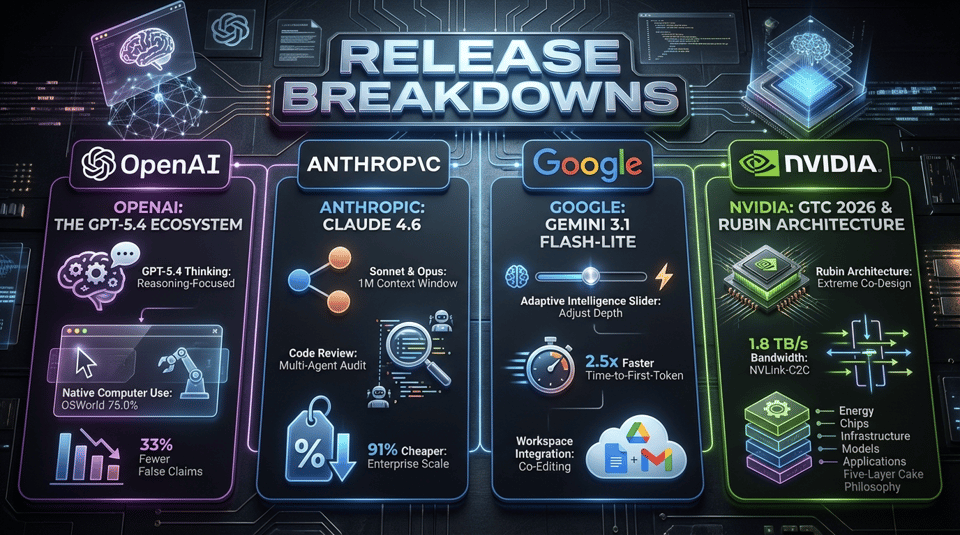
The current period witnessed major architectural updates from the primary frontier model developers, focusing intensely on autonomous execution, advanced reasoning efficiency, and significant cost reduction for enterprise workloads.
OpenAI: The GPT-5.4 Ecosystem
What Launched: OpenAI introduced GPT-5.4, a comprehensive update that phases out older models and segments offerings into distinct performance tiers aimed at complex enterprise knowledge work.[1] The release includes "GPT-5.4 Thinking," a reasoning-focused model that outlines its computational plan prior to generating an answer, allowing users to course-correct mid-process.[1] Most notably, the release includes native computer-use capabilities via API, and a "GPT-5.4 Pro" tier for maximum reasoning performance.[5]
Practical Significance: The model demonstrates a 33% reduction in false claims and an 18% reduction in full-response errors compared to its predecessor, significantly addressing enterprise hallucination concerns.[19] It is highly efficient, utilizing fewer tokens to reach conclusions, and boasts a 1 million token context window.[19] Its native computer use fundamentally changes how developers build automation agents, shifting from text parsing to direct OS manipulation, achieving a 75.0% score on the OSWorld benchmark.[2] The release also ends the rumored internal "Code Red" at OpenAI, signaling a stabilization of their product roadmap.[42]
Who Should Care: Developers building agentic applications, enterprise knowledge workers, data analysts, and software engineers leveraging the Codex platform.[1]
Anthropic: Claude 4.6 (Sonnet and Opus)
What Launched: Anthropic advanced its model family with the 4.6 iteration in February 2026, emphasizing software engineering capabilities, rigorous security, and cost-effective intelligence.[43] Claude Sonnet 4.6 was introduced as the default for free and Pro users, offering a 1 million token context window.[44] Claude Opus 4.6 remains the premium model for multidisciplinary advanced logic.[44] Additionally, Anthropic introduced "Code Review," an agentic tool integrated into Claude Code that conducts deep, multi-agent reviews of GitHub pull requests.[46]
Practical Significance: Sonnet 4.6 provides a massive pricing advantage for enterprise-scale deployments. Priced at $3 per million input tokens and $15 per million output tokens, it costs approximately 91% less than competing high-end professional models while maintaining comparable, near-frontier benchmark performance.[45] The Code Review tool addresses the emerging industry crisis of "vibe coding"—where AI-assisted developers generate code faster than human reviewers can safely audit it, leading to deployed vulnerabilities.[46]
Who Should Care: Software engineering managers, DevOps teams, enterprise system architects, and organizations scaling high-volume API infrastructure.[44]
Google: Gemini 3.1 Flash-Lite
What Launched: Google expanded its Gemini 3 family with Gemini 3.1 Flash-Lite, a natively multimodal model heavily optimized for speed, low latency, and massive data volume processing.[47] The model features a 1 million token input context and is priced aggressively at $0.25 per million input tokens.[47]
Practical Significance: The release introduces an "Adaptive Intelligence" slider, allowing developers to manually adjust the cognitive processing depth of the model.[48] For simple classification or translation tasks, developers can utilize "Low Thinking" to maximize speed and minimize cost; for complex analysis, processing depth can be increased.[48] It achieves a 2.5x faster time-to-first-token compared to older iterations.[48] This release also rectifies severe bugs found in the early 2026 rollout of Gemini 3.0 Pro, including "Temporal Shock" (where the model hallucinated 2026 news as simulated data) and deep backend state conflicts.[49] Concurrently, Google deeply integrated Gemini into Google Workspace for co-editing across Docs and Gmail.[50]
Who Should Care: High-volume data processing teams, enterprise procurement officers seeking extreme cost-efficiency, and Google Workspace power users.[47]
NVIDIA: GTC 2026 and the Rubin Architecture
What Launched: Ahead of the NVIDIA GTC 2026 conference, detailed specifications regarding the next-generation AI hardware ecosystem emerged, centered around the new "Rubin" architecture.[52] The platform introduces extreme co-design across components, featuring the Vera CPU, HBM4 memory supplied by SK Hynix, and second-generation NVLink-C2C providing 1.8 TB/s of coherent bandwidth between CPUs and GPUs.[52]
Practical Significance: The Rubin architecture addresses the massive data movement overhead that throttles current AI training.[55] By treating LPDDR5X and HBM4 as a single coherent memory pool, it enables highly efficient multi-model operations and massive inference scaling.[55] The event also solidifies NVIDIA's "Five-Layer Cake" philosophy (Energy, Chips, Infrastructure, Models, Applications), highlighting strategic partnerships in silicon photonics with Coherent and Lumentum to resolve networking bottlenecks.[53]
Who Should Care: Cloud infrastructure providers, AI hardware investors, high-performance computing (HPC) architects, and large-scale model training laboratories.[52]
Implementation Resources
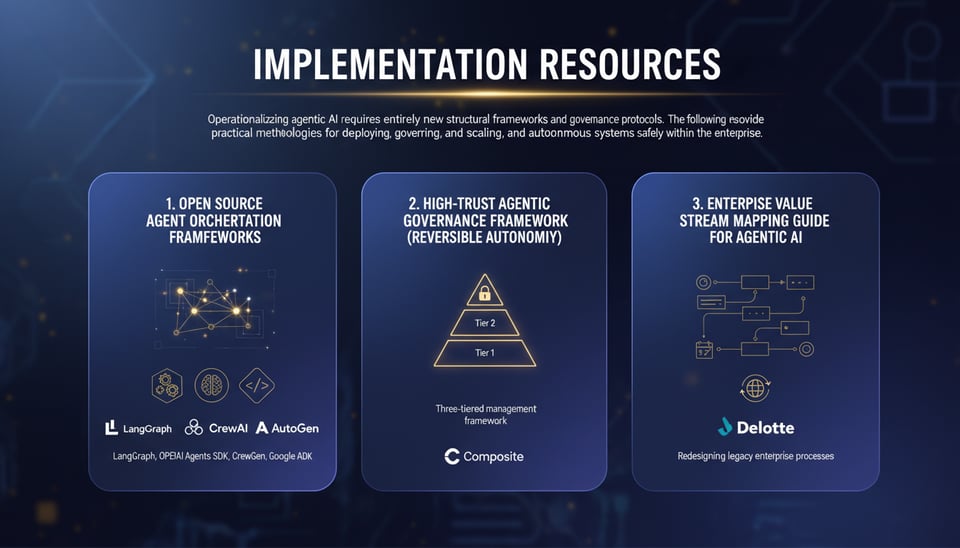
Operationalizing agentic AI requires entirely new structural frameworks and governance protocols. The following resources provide practical methodologies for deploying, governing, and scaling autonomous systems safely within the enterprise.
1. Open Source Agent Orchestration Frameworks
What It Is: A vast ecosystem of open-source architectural toolboxes designed to build multi-agent systems, moving away from monolithic chatbot interfaces. Leading frameworks include LangGraph (34.5M monthly downloads), OpenAI Agents SDK, CrewAI, AutoGen, and Google ADK.[58]
Why It Is Useful: Building agentic systems from scratch without a framework results in brittle code that fails under edge cases.[58] Frameworks like LangGraph allow developers to explicitly define the execution flow as a mathematical graph—where nodes represent tool calls or memory updates, and edges define decision paths.[58] This ensures clear execution logic, reliable state handling, and robust debugging capabilities for long-running autonomous processes.[58]
Who It Is For: AI engineers, technical product managers, and software architects tasked with building complex, multi-step enterprise automation systems.[58]
2. High-Trust Agentic Governance Framework (Reversible Autonomy)
What It Is: A three-tiered operational management framework developed by Composite, designed specifically to secure high-trust agentic systems and prevent "rubber-stamping"—a critical danger where human operators blindly approve AI actions due to perceived accuracy.[61]
Why It Is Useful: The framework introduces the concept of "Reversible Autonomy," where AI actions are executed but held in a "proposal state" pending final human verification.[61] It classifies tasks into three strict operational tiers: Tier 1 (100% autonomous routine tasks like calendar syncs), Tier 2 (AI-drafted, human-reviewed complex synthesis), and Tier 3 (AI-restricted highly sensitive legal/pastoral actions).[61] This structure allows mission-driven organizations (healthcare, non-profits, religious institutions) to automate their administrative burden without sacrificing human empathy, privacy, or critical oversight.[61]
Who It Is For: Risk management officers, compliance teams, and operations directors operating in highly regulated, sensitive, or high-trust sectors.[61]
3. Enterprise Value Stream Mapping Guide for Agentic AI
What It Is: A strategic methodology and diagnostic approach championed by firms like Deloitte to redesign legacy enterprise processes specifically to maximize the utility of autonomous AI labor.[16]
Why It Is Useful: The guide provides a structured approach to prevent the inefficient layering of advanced AI agents on top of outdated, human-centric processes.[16] It forces organizations to map how workflows should operate in a friction-free environment, rather than how they historically have operated.[16] By treating AI agents as a new form of collaborative labor, organizations can uncover massive efficiency gains, successfully shifting their oversight from a bottlenecked human-in-the-loop model to a highly scalable human-on-the-loop paradigm.[16]
Who It Is For: Chief Operating Officers, digital transformation leads, enterprise strategy consultants, and Chief Information Officers.[16]
Performance and Benchmarks
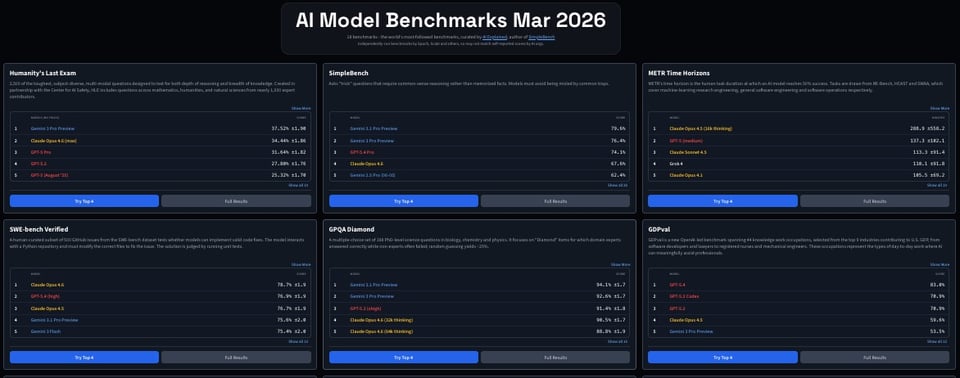
Evaluating frontier models requires looking past corporate marketing claims. March 2026 testing data indicates that while generalized logic evaluations are saturating, highly specialized benchmarks reveal distinct, actionable performance disparities between competing architectures.
GPT-5.4 vs. Claude 4.6 Performance Matrix
What Was Tested: The top-tier models from OpenAI and Anthropic were subjected to independent testing across coding (SWE-bench), computer navigation (OSWorld), general knowledge (MMLU), and professional task completion (GDPval) to determine production viability.[5]
What The Results Show: The testing data reveals a highly competitive landscape where specific use-cases dictate model selection.
| Benchmark / Capability | Claude Sonnet 4.6 | Claude Opus 4.6 | GPT-5.4 |
|---|---|---|---|
| MMLU-Pro (General Knowledge) | 88.0% | 89.5% | 88.7% |
| SWE-Bench Verified (Coding) | 76.2% | 80.8% | 75.8% |
| OSWorld (Computer Use) | 53.0% | 48.5% | 75.0% |
| GDPval (Professional Tasks) | 81.1% | 82.0% | 83.0% |
| Input Cost (per 1M tokens) | $3.00 | $5.00 | $2.50 |
| Output Cost (per 1M tokens) | $15.00 | $25.00 | $15.00 |
GPT-5.4 establishes a massive, paradigm-shifting lead in autonomous computer navigation (OSWorld), outperforming competitors by a wide margin (75.0% vs 53.0%).[5] It is currently the premier model for executing generalized office software tasks and generating long-horizon deliverables like financial models.[19] Conversely, Anthropic’s Claude Opus 4.6 maintains the absolute lead in complex software engineering and codebase refactoring (80.8% on SWE-Bench).[64] Most notably for enterprise budgets, Claude Sonnet 4.6 offers near-flagship capability at a lower price than Claude Opus 4.6, while GPT-5.4 remains cheaper on input tokens and matches Sonnet 4.6 on output pricing.[45]
Cautions or Limitations: Time-to-first-token (TTFT) metrics show GPT models starting slightly faster than Claude models (0.4s vs 0.6s), though this is only perceptible in real-time interactive applications and is negligible for CI-driven batch processing.[65] Furthermore, standard coding benchmarks often fail to capture deep logic bugs and multi-file architectural consistency, an area where Anthropic's models historically excel in real-world deployments via "Vibe-Coding".[66]
The Saturation of Academic Mathematics and FrontierMath
What Was Tested: The performance of top-tier artificial intelligence systems on advanced, research-level mathematical tasks.[67]
What The Results Show: Current frontier models have essentially saturated standard academic evaluations like GSM8K and MATH, which test high-school and collegiate mathematics, achieving near-perfect scores.[67] In response, Epoch AI introduced FrontierMath, a new benchmark featuring original, exceptionally challenging mathematical problems spanning number theory, algebraic geometry, and category theory.[67] These are novel problems vetted by expert mathematicians that typically require human researchers hours, days, or collaborative efforts to solve.[67]
Cautions or Limitations: While models like OpenAI's latest variants perform exceptionally well on filtered math arenas (such as the LMSYS Math Leaderboard), their performance drops drastically on FrontierMath.[67] This paradigm shift in benchmarking demonstrates that while AI is incredibly proficient at retrieving and applying known formulas to collegiate problems, true artificial general intelligence capable of original research-level mathematical discovery remains a distant, unsolved challenge.[67]
References
[6] Verve Group. "Verve Group launches industry-first targeting capability activating conversational intent signals from major LLM environments." https://press.verve.com/verve-group-launches-industry-first-targeting-capability-activating-conversational-intent-signals-from-major-llm-environments
[38] Mayer Brown. "Supreme Court Denies Review in AI Authorship Case." https://www.mayerbrown.com/en/insights/publications/2026/03/supreme-court-denies-review-in-ai-authorship-case
[7] SiliconANGLE. "AI networking startup Nexthop AI raises $500M, launches new switches." https://siliconangle.com/2026/03/10/ai-networking-startup-nexthop-ai-raises-500m-launches-new-switches/
[9] Nieman Lab. "As AI data centers scale, investigating their impact becomes its own beat." https://www.niemanlab.org/2026/03/as-ai-data-centers-scale-investigating-their-impact-becomes-its-own-beat/
[23] Times of India. "The women writing AI's rulebook." https://timesofindia.indiatimes.com/technology/times-techies/the-women-writing-ais-rulebook/articleshow/129429977.cms
[1] Times of India. "OpenAI launches GPT-5.4 in ChatGPT..." https://timesofindia.indiatimes.com/technology/tech-news/openai-launches-gpt-5-4-in-chatgpt-claimed-to-support-up-to-1m-tokens-of-context/articleshow/129133389.cms
[19] Business Today. "OpenAI releases GPT-5.4 model with advanced reasoning, coding, and native computer use." https://www.businesstoday.in/technology/news/story/openai-releases-gpt-54-model-with-advanced-reasoning-coding-and-native-computer-use-519373-2026-03-06
[40] Gadgets360. "OpenAI Releases GPT-5.4 AI Models With Agentic Computer-Use Capabilities." https://www.gadgets360.com/ai/news/openai-gpt-5-4-thinking-pro-ai-models-agentic-computer-use-reasoning-improvements-details-11176030
[42] Gadgets360. "ChatGPT Adult Mode Delayed Again as OpenAI's 'Code Red' Reportedly Ends." https://www.gadgets360.com/ai/news/openai-code-red-over-chatgpt-adult-mode-delay-report-11191231
[41] Help Net Security. "OpenAI's GPT-5.4 doubles down on safety as competition heats up." https://www.helpnetsecurity.com/2026/03/06/openai-chatgpt-gpt%E2%80%915-4-model-release/
[43] Intuition Labs. "Anthropic Claude 4: The Next-Generation AI Collaborator." https://intuitionlabs.ai/articles/anthropic-claude-4-llm-evolution
[10] Medium. "Anthropic's explosive start to 2026..." https://fazal-sec.medium.com/anthropics-explosive-start-to-2026-everything-claude-has-launched-and-why-it-s-shaking-up-the-668788c2c9de
[44] MacRumors. "Anthropic Releases Claude Sonnet 4.6." https://www.macrumors.com/2026/02/17/anthropic-releases-claude-sonnet-4-6/
[50] Google Workspace. "Reimagining content creation with Gemini..." https://workspace.google.com/blog/product-announcements/reimagining-content-creation
[47] Google DeepMind. "Gemini 3.1 Flash-Lite Model Card." https://deepmind.google/models/model-cards/gemini-3-1-flash-lite/
[48] Times of India. "Google Gemini 3.1 Flash-Lite launched..." https://timesofindia.indiatimes.com/technology/tech-news/google-gemini-3-1-flash-lite-launched-how-it-is-different-previous-model/articleshow/129087579.cms
[49] Reddit. "Gemini 3.0 is being shut down March 9, but 3.1 is..." https://www.reddit.com/r/GeminiAI/comments/1rifn5g/gemini_30_is_being_shut_down_march_9_but_31_is/
[51] 9to5Google. "Google Docs upgrades now let you co-edit with Gemini." https://9to5google.com/2026/03/10/google-docs-gemini-upgrade/
[56] NVIDIA News. "NVIDIA CEO Jensen Huang and Global Technology Leaders to Showcase Age of AI at GTC 2026." https://nvidianews.nvidia.com/news/nvidia-ceo-jensen-huang-and-global-technology-leaders-to-showcase-age-of-ai-at-gtc-2026
[33] European Commission. "Regulatory framework AI." https://digital-strategy.ec.europa.eu/en/policies/regulatory-framework-ai
[69] TechLaw. "EU AI Act – the Current Timeline." https://www.techlaw.ie/2026/03/articles/artificial-intelligence/eu-ai-act-timeline-update/
[31] Petrie-Flom Center. "Simplification or Back to Square One? The Future of EU Medical AI Regulation." https://petrieflom.law.harvard.edu/2026/03/05/simplification-or-back-to-square-one-the-future-of-eu-medical-ai-regulation/
[70] LMCouncil. "Benchmarks." https://lmcouncil.ai/benchmarks
[71] HuggingFace. "Arena Leaderboard." https://huggingface.co/spaces/lmarena-ai/arena-leaderboard
[67] Stanford HAI. "AI Index Report 2025, Chapter 2: Technical Performance." https://hai.stanford.edu/assets/files/hai_ai-index-report-2025_chapter2_final.pdf
[22] Deloitte. "State of AI in the Enterprise 2026." https://www.deloitte.com/us/en/what-we-do/capabilities/applied-artificial-intelligence/content/state-of-ai-in-the-enterprise.html
[20] PwC. "2026 AI Business Predictions." https://www.pwc.com/us/en/tech-effect/ai-analytics/ai-predictions.html
[18] Gartner. "Gartner Predicts 40 Percent of Enterprise Apps Will Feature Task-Specific AI Agents by 2026." https://www.gartner.com/en/newsroom/press-releases/2025-08-26-gartner-predicts-40-percent-of-enterprise-apps-will-feature-task-specific-ai-agents-by-2026-up-from-less-than-5-percent-in-2025
[15] GlobeNewswire. "Enterprise AI Automation Budgets Driving 53% Surge in Use of AI Workers." https://markets.businessinsider.com/news/stocks/enterprise-ai-automation-budgets-driving-53-surge-in-use-of-ai-workers-1035913618
[61] Forbes. "Operationalizing Empathy: A 3-Tiered Governance Framework For High-Trust Agentic AI." https://www.forbes.com/councils/forbestechcouncil/2026/03/10/operationalizing-empathy-a-3-tiered-governance-framework-for-high-trust-agentic-ai/
[20] PwC. "AI Business Predictions." https://www.pwc.com/us/en/tech-effect/ai-analytics/ai-predictions.html
[16] Deloitte. "Agentic AI strategy." https://www.deloitte.com/us/en/insights/topics/technology-management/tech-trends/2026/agentic-ai-strategy.html
[2] Medium. "GPT-5.4 Native Computer Use." https://cobusgreyling.medium.com/gpt-5-4-native-computer-use-c8ad242d60a2
[4] Microsoft Tech Community. "Introducing GPT-5.4 in Microsoft Foundry." https://techcommunity.microsoft.com/blog/azure-ai-foundry-blog/introducing-gpt-5-4-in-microsoft-foundry/4499785
[3] Reddit. "How to use Computer use and vision." https://www.reddit.com/r/ChatGPTPro/comments/1rmfauw/how_to_use_computer_use_and_vision/
[5] GLBGPT. "How to use ChatGPT 5.4." https://www.glbgpt.com/hub/how-to-use-chatgpt-5-4/
[39] OpenAI Help. "GPT-5.3 and GPT-5.4 in ChatGPT." https://help.openai.com/en/articles/11909943-gpt-53-and-gpt-54-in-chatgpt
[45] AnotherWrapper. "Claude Sonnet 4.6 vs gpt-5.4-pro." https://anotherwrapper.com/tools/llm-pricing/gpt-54-pro/claude-sonnet-46
[66] GLBGPT. "GPT-5.4 vs Claude Opus 4.6." https://www.glbgpt.com/hub/gpt-5-4-vs-claude-opus-4-6/
[58] Medium. "10 Open Source Agent Frameworks for Building Custom Agents in 2026." https://medium.com/@techlatest.net/10-open-source-agent-frameworks-for-building-custom-agents-in-2026-4fead61fdc7c
[59] Firecrawl. "Best Open Source Agent Frameworks." https://www.firecrawl.dev/blog/best-open-source-agent-frameworks
[60] DataCamp. "Best AI agents." https://www.datacamp.com/blog/best-ai-agents
[32] OneTrust. "EU Digital Omnibus Proposes Delay of AI Compliance Deadlines." https://www.onetrust.com/blog/eu-digital-omnibus-proposes-delay-of-ai-compliance-deadlines/
[37] Global Policy Watch. "EU Regulators Issue Opinion on Revisions of GDPR and Other Data Laws." https://www.globalpolicywatch.com/2026/02/eu-regulators-issue-opinion-on-revisions-of-gdpr-and-other-data-laws/
[25] Anthropic. "Statement from Dario Amodei on our discussions with the Department of War." https://www.anthropic.com/news/statement-department-of-war
[26] Daily Nous. "Anthropic's Statement on the Department of War's Demands." https://dailynous.com/2026/02/27/anthropics-statement-on-the-department-of-wars-demands/
[29] Sahm Capital. "Anthropic gives statement from Dario Amodei..." https://www.sahmcapital.com/news/content/brief-anthropic-gives-statement-from-dario-amodei-on-discussions-with-the-department-of-war-2026-02-27
[28] Stanford CS182. "Policy Memo: CS182." https://web.stanford.edu/class/cs182/handouts/06PolicyMemo.pdf
[30] Times of India. "Pentagon makes it clear to Anthropic CEO..." https://timesofindia.indiatimes.com/technology/tech-news/pentagon-makes-it-clear-to-anthropic-ceo-dario-amodei-that-they-do-not-want-anything-to-do-with-the-company-now-and-tells-everyone-want-to-end-all-speculation-there-is-/articleshow/129255194.cms
[16] Deloitte. "Value stream mapping for AI agents guide." https://www.deloitte.com/us/en/insights/topics/technology-management/tech-trends/2026/agentic-ai-strategy.html
[21] Deloitte. "AI agent orchestration." https://www.deloitte.com/us/en/insights/industry/technology/technology-media-and-telecom-predictions/2026/ai-agent-orchestration.html
[17] Deloitte. "Intel Alliance: Agentic AI for enterprise." https://www.deloitte.com/us/en/alliances/articles/intel-alliance-agentic-ai-for-enterprise.html
[34] European Commission. "Digital Package FAQs." https://digital-strategy.ec.europa.eu/en/faqs/digital-package
[35] Usercentrics. "EU Digital Omnibus Package." https://usercentrics.com/knowledge-hub/eu-digital-omnibus-package/
[36] Bird & Bird. "Digital Omnibus Package: Single EU harmonised incident reporting regime." https://www.twobirds.com/en/insights/2025/digital-omnibus-package-single-eu-harmonised-incident-reporting-regime-across-cyber-and-data-protect
[62] Artificial Analysis. "GPT-5.4 vs Claude Sonnet 4.6." https://artificialanalysis.ai/models/comparisons/gpt-5-4-vs-claude-sonnet-4-6-adaptive
[65] SitePoint. "Claude Sonnet 4.6 vs GPT-5.4: The 2026 Developer Benchmark." https://www.sitepoint.com/claude-sonnet-4-6-vs-gpt-5-the-2026-developer-benchmark/
[64] Medium. "Nobody Wins the AI Crown in March 2026." https://medium.com/ai-in-plain-english/nobody-wins-the-ai-crown-in-march-2026-not-even-gpt-5-4-b5db7043c762
[63] Price Per Token. "Benchmark Leaderboards." https://pricepertoken.com/leaderboards/benchmark
[52] TradingKey. "Nvidia GTC 2026 Preview: Vera Rubin & Feynman." https://www.tradingkey.com/analysis/stocks/us-stocks/261657446-nvidia-gtc-2026-preview-vera-rubin-feynman-tradingkey
[57] Technetbooks. "Nvidia GTC 2026 Silicon Photonics Rubin Ultra Architecture." https://www.technetbooks.com/2026/03/nvidia-gtc-2026-silicon-photonics-rubin.html
[54] Technetbooks. "SK Hynix Nvidia HBM4 Memory Supply." https://www.technetbooks.com/2026/03/sk-hynix-nvidia-hbm4-memory-supply.html
[55] Reddit. "Nvidia launches powerful new Rubin chip." https://www.reddit.com/r/hardware/comments/1q53ow8/nvidia_launches_powerful_new_rubin_chip/
[11] Medium. "Anthropic Launch Claude Code Security." https://medium.com/@zakpatrikcz/anthropic-launch-claude-code-security-305e8df0ccb5
[13] SC Magazine. "Mozilla fixes 22 Firefox vulnerabilities discovered by Anthropic's Claude AI." https://www.scworld.com/news/mozilla-fixes-22-firefox-vulnerabilities-discovered-by-anthropics-claude-ai
[46] Gadgets360. "Anthropic Introduces Agentic Code Review Tool to Claude Code." https://www.gadgets360.com/ai/news/anthropic-ai-agentic-code-review-tool-to-claude-code-introduced-11193478
[12] Anthropic. "Claude Code Security." https://www.anthropic.com/news/claude-code-security
[14] Anthropic. "Mozilla Firefox Security." https://www.anthropic.com/news/mozilla-firefox-security
[24] Anthropic. "AI Fluency Index." https://www.anthropic.com/research/AI-fluency-index
[27] Anthropic. "Department of War Statements." https://www.anthropic.com/news
[8] NVIDIA. "State of AI Report 2026." https://blogs.nvidia.com/blog/state-of-ai-report-2026/
[22] Deloitte. "State of AI in the Enterprise 2026." https://www.deloitte.com/us/en/what-we-do/capabilities/applied-artificial-intelligence/content/state-of-ai-in-the-enterprise.html
[56] NVIDIA. "GTC 2026 Keynote & 5-Layer Cake." https://nvidianews.nvidia.com/news/nvidia-ceo-jensen-huang-and-global-technology-leaders-to-showcase-age-of-ai-at-gtc-2026
[32] OneTrust. "EU Digital Omnibus Timeline." https://www.onetrust.com/blog/eu-digital-omnibus-proposes-delay-of-ai-compliance-deadlines/
[45] Anthropic. "Pricing." https://docs.anthropic.com/en/docs/about-claude/pricing
[10] Medium. "Claude Code Security Tool Details." https://fazal-sec.medium.com/anthropics-explosive-start-to-2026-everything-claude-has-launched-and-why-it-s-shaking-up-the-668788c2c9de
[8] NVIDIA. "5-Layer Cake Graphic reference." https://blogs.nvidia.com/blog/state-of-ai-report-2026/