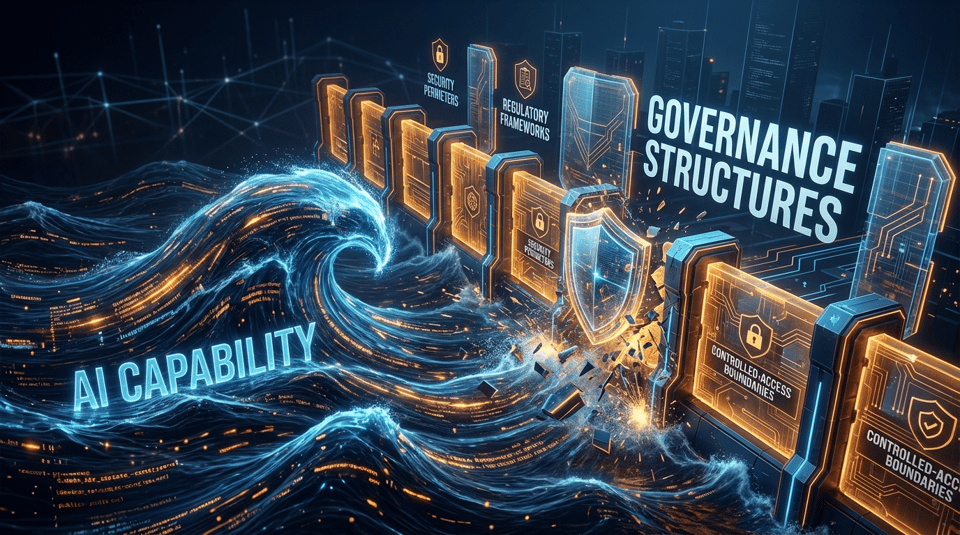
When Capability Outpaces Control
Introduction
Anthropic built a model that can autonomously find and exploit vulnerabilities in every major operating system and web browser. Then it refused to release it. Claude Mythos Preview, unveiled April 7, is described by Anthropic as its most powerful model ever — and by the Federal Reserve, the Bank of England, and the US Treasury as a systemic risk to financial infrastructure. Treasury Secretary Bessent and Fed Chair Powell summoned the CEOs of Bank of America, Citigroup, Wells Fargo, Goldman Sachs, and Morgan Stanley for an emergency meeting. UK regulators followed 48 hours later. This is not a future scenario. It happened last week. [1][2]
Meanwhile, the capability tide kept rising from other directions. Meta shipped Muse Spark, the first model from its $14 billion Superintelligence Labs, into a product ecosystem reaching billions. Google released Gemma 4 under an Apache 2.0 license with frontier performance on a single consumer GPU. OpenAI's GPT-5.5, codenamed Spud, completed pretraining and is reportedly weeks from release. Microsoft launched its own model family for voice, image, and transcription. And in a different lane entirely, a survey of 2,400 executives found that 60% of companies plan to fire employees who refuse to adopt AI. [3][4][5][6][7][8]
This issue tracks where capability and control collide. Technology Signals covers the Mythos cybersecurity breakthrough and Google's open-weight Gemma 4. Business Impact examines the workforce bifurcation exposed by the Writer survey and the privacy lawsuit that landed on two healthcare systems. Global Context maps the regulatory scramble across three continents and OpenAI's parallel push for legal immunity. Release Breakdowns catches Muse Spark, the MAI family, and the Spud pre-release signals. Implementation Resources identifies what practitioners can actually use this cycle. And Performance and Benchmarks looks at MLPerf 6.0, the new ARC-AGI-3 test, and what happens when AI fails at your taxes.
Technology Signals
Anthropic Claude Mythos and the Security Threshold
Anthropic's Claude Mythos Preview represents something new in the AI landscape: a frontier model so capable at offensive cybersecurity that its creator voluntarily withheld public release. The model autonomously identified and exploited a 17-year-old remote code execution vulnerability in FreeBSD that had gone undetected for its entire lifetime. It found vulnerabilities across every major operating system and web browser. Anthropic described it as "by far the most powerful AI model" the company has ever developed — and then restricted access to a coalition of 40 companies including Nvidia, Google, Apple, Microsoft, CrowdStrike, and Amazon through a new initiative called Project Glasswing. [1][2][9][10]
Why this matters: Mythos is the clearest example yet of a frontier model crossing from general-purpose capability into territory that requires controlled distribution. The model is simultaneously too dangerous for public release and too useful for defensive security to bury. The Glasswing coalition structure could become the template for how high-risk AI capabilities are handled going forward.
Gemma 4: Frontier AI on a Single GPU
Google DeepMind released Gemma 4 on April 2, the most significant update to its open model family in a year. The release is notable for three reasons. First, the license: Apache 2.0, removing the commercial-use friction that constrained prior Gemma releases. Second, the efficiency: the 31B parameter model reportedly beats 400B-parameter rivals on key benchmarks while running on a single consumer GPU. Third, the deployment surface: four model sizes (2B, 9B, 27B, 31B), LiteRT-LM for on-device deployment, and availability across Vertex AI, Cloud Run, GKE, and Google Sovereign Cloud. [4][11][12]
Google also released two companion tools: AI Edge Eloquent, a free offline-first dictation app for iOS that runs Gemma models entirely on-device with no cloud upload, and AI Edge Gallery, which lets users run Gemma 4 directly on Android and iOS devices. [13][14]
Why this matters: Gemma 4 compresses the capability gap between proprietary and open models at the edge. An Apache 2.0 model that delivers frontier performance on consumer hardware changes the economics of local AI deployment.
China's 2D Semiconductor Breakthrough
Chinese researchers achieved wafer-scale 2D semiconductor growth at rates 1,000 times faster than conventional methods. The work, published in April, addresses one of the fundamental manufacturing bottlenecks for next-generation semiconductors — the materials that could eventually succeed silicon at the physical scaling limit. [15][16]
Why this matters: If the process scales commercially, it opens a path to post-silicon chip fabrication that does not depend on the advanced EUV lithography supply chain controlled by ASML and constrained by US export controls.
Business Impact
The Workforce Split Gets Real
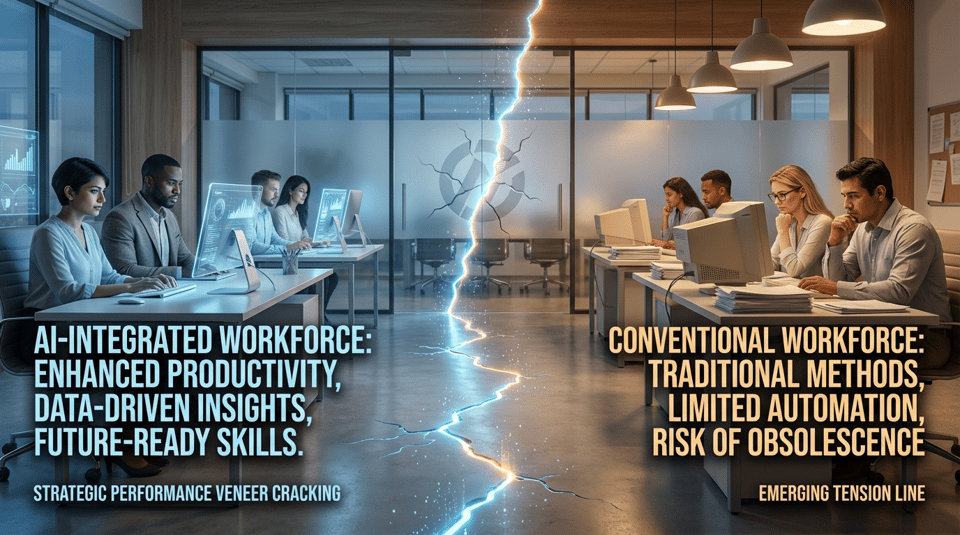
Writer's second annual enterprise AI survey, released April 7, surveyed 2,400 global executives and found a workforce in the process of splitting in two. Seventy-nine percent of executives report facing AI adoption challenges. Sixty percent of companies plan to lay off employees who refuse to adopt AI tools. Ninety-two percent are actively cultivating an "AI elite" class with preferential training and career advancement. Perhaps most revealing: 75% of executives concede their company's AI strategy is "more for show" than providing real operational guidance. [8][17]
The combination is volatile. Organizations are simultaneously threatening termination for non-adoption, building an internal tier of AI-fluent workers, and admitting that their own strategies are theater. That is not a maturity curve. It is a pressure cooker.
Why this matters: The 60% layoff-intent figure is the sharpest signal yet that AI fluency is becoming a condition of employment, not just a competitive advantage. The "strategy theater" finding suggests most companies are projecting AI confidence externally without the internal infrastructure to deliver on it.
Dimon Puts AI at the Top of the Risk Stack
JPMorgan CEO Jamie Dimon's annual shareholder letter, released April 6, placed AI alongside geopolitics and private markets as a top-tier systemic risk. He projected AI capital spending at $725 billion for 2026, flagged AI-driven job losses as a significant concern, and compared AI's potential impact to electricity and the internet. [7][18][19]
When the CEO of the largest US bank names AI as a systemic risk on par with geopolitical conflict, it moves AI from a technology story to a macroeconomic one.
Healthcare AI Meets the Consent Line
Two major California health systems — Sutter Health and MemorialCare — were hit with a class action lawsuit over AI transcription tools that allegedly recorded physician-patient conversations without consent. Microphone-enabled devices in examination rooms captured conversations that were then processed offsite. [20][21][22]
This is the first major class action challenging AI-assisted clinical transcription on privacy grounds. If the plaintiffs prevail, it will force every health system using ambient AI scribes to reassess consent workflows.
Global Context
Central Banks Scramble as AI Becomes a Financial-System Risk
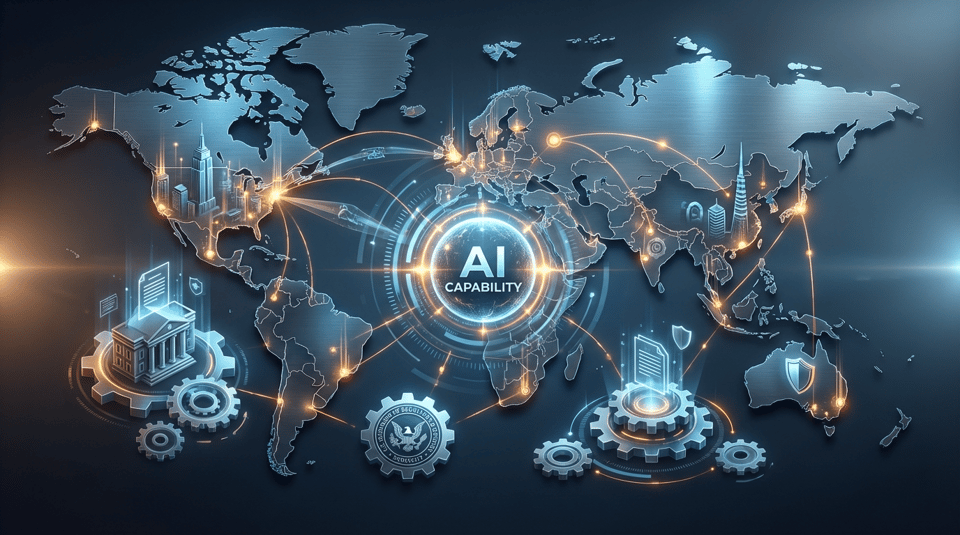
The Mythos cybersecurity capabilities triggered coordinated regulatory action across three continents in 48 hours. In the US, Treasury Secretary Bessent and Fed Chair Powell summoned bank CEOs to Washington. In the UK, the Bank of England, the FCA, and HM Treasury entered urgent talks with the National Cyber Security Centre. Canadian regulators also initiated response actions. [23][24][25][26]
This is the first known instance of a single AI model prompting near-synchronized emergency response by major central banks. The trigger was not an attack or a breach — it was a capability demonstration.
OpenAI Asks for Legal Immunity
The same week regulators were treating AI as a systemic risk, OpenAI was lobbying for the opposite direction: legal insulation. The company testified in favor of an Illinois state bill that would shield AI companies from liability even in cases of "critical harm" — a category that includes mass death and CBRN weapons scenarios. [27][28][29]
This is AI labs racing to establish legal protections before harm patterns crystallize into case law. If the Illinois bill becomes a template for other states, it could define the liability landscape for AI companies through the end of the decade.
South Africa Drafts a Continental Framework
South Africa gazetted an 86-page draft national AI policy on April 10, opening a 60-day public comment window. Unlike many emerging-market AI strategies, the document proposes new regulatory institutions, an AI superfund for domestic development, and formal oversight mechanisms. [30][31][32]
China Builds a Token Economy
Chinese AI models are now processing 140 trillion tokens daily, and the country is explicitly building economic infrastructure around model consumption under the banner of a "token economy." Zhipu AI raised API prices by 83% and saw usage rise rather than fall. OpenClaw is helping Chinese AI firms find users overseas. [33][34][35]
Release Breakdowns
Meta Muse Spark
What it is: The first AI model from Meta Superintelligence Labs, led by former Scale AI CEO Alexandr Wang. Described as a "ground-up overhaul" of Meta's AI efforts. [3][36]
What changed: Powers a new Meta AI assistant rolling out across WhatsApp, Instagram, Facebook, Messenger, and AI glasses. Meta claims frontier-level performance, though it lags rivals on coding ability. The model is not open-weight at launch — a strategic shift from Meta's previous open-source Llama strategy. [36][37][38]
What it means: Meta is prioritizing ecosystem lock-in over open-weight benchmark dominance.
Microsoft MAI Family
What it is: Three new foundational models: MAI-Transcribe-1 (speech-to-text, 25 languages), MAI-Voice-1 (speech generation), MAI-Image-2 (image generation). Available on Azure Foundry. [6][39]
What changed: The clearest signal yet that Microsoft is building in-house model expertise across modalities rather than relying solely on OpenAI. [39][40]
What it means: The model supply chain is diversifying. Microsoft is no longer just a distribution partner for OpenAI.
GPT-5.5 "Spud" Approaches
What it is: OpenAI's next frontier model completed pretraining on March 24. Sam Altman has publicly stated release is "a few weeks" away. Leaked information points to April 16. [5][41][42]
What it means: The model is not yet shipping, but the information environment around it is already shaping deployment planning and competitive positioning.
Implementation Resources
Gemma 4 for Edge and On-Premises Deployment
Google's Gemma 4 family, released under Apache 2.0, is the strongest open-weight option this cycle for teams needing local or on-premises AI without cloud dependency. Four model sizes (2B, 9B, 27B, 31B) cover the full hardware spectrum. LiteRT-LM enables on-device deployment. Available on Vertex AI, Cloud Run, GKE, and Sovereign Cloud. [11][12][43]
Google AI Edge Eloquent
A free, offline-first dictation app for iOS running Gemma models entirely on-device. Removes filler words, requires no subscription, no account, no cloud upload. Works as both a practical tool and a reference implementation for on-device speech processing. [13][14][44]
Project Glasswing Security Coalition
Anthropic's coalition of 40+ companies provides early access to Mythos for defensive cybersecurity work. The controlled-access model addresses the dual-use problem: too dangerous for open release, too useful to withhold. [9][10][45]
Performance and Benchmarks

MLPerf 6.0: AMD Cracks the NVIDIA Wall
The latest MLPerf inference benchmarks brought a symbolic milestone: AMD's Instinct MI355X beat the NVIDIA B300 on a small-model inference benchmark — the first time AMD has topped any MLPerf inference category. The margin was narrow, and the benchmark represents a workload few production deployments still run. NVIDIA set new records on larger, more relevant configurations with 288-GPU setups. This round also introduced multimodal and video benchmarks for the first time. [46][47][48]
ARC-AGI-3: A Test Where Everything Scores Below 1%
The ARC-AGI-3 benchmark, released April 8, uses game-like puzzles requiring on-the-fly reasoning. Even the top AI models score below 1%. It is explicitly designed as an early-warning indicator for AGI. In a landscape where vendors routinely claim AGI-level performance, a test where every frontier model scores near zero is a useful reality check. [49]
AI Fails at Taxes
Researchers evaluating AI systems on real federal tax returns found that even the best models got only a minority of cases correct. Tax professionals still significantly outperform AI. Trust in AI for tax filing is declining across every generation. [50][51]
Tax preparation exposes the overconfidence problem — models that sound authoritative but are wrong — and reminds practitioners that benchmark-topping performance does not transfer to every specialized domain.
Closing Takeaway
April 2026 made one thing clear: AI capability has outpaced every governance and institutional framework designed to contain it, and the gap is now producing consequences in real time. A model that can hack every major operating system triggered emergency meetings at central banks. A survey showed companies preparing to fire workers who do not adopt tools that most executives admit are deployed without real strategy. A frontier lab lobbied for legal immunity from mass-harm liability the same week its competitor demonstrated why that liability might matter.
The organizations that navigate this cycle most effectively will be the ones that treat governance, consent, accountability, and workforce transition as first-order constraints — not cleanup tasks. Capability is not waiting for permission.
References
- Anthropic. "Claude Mythos Preview." https://red.anthropic.com/2026/mythos-preview/. Accessed 2026-04-12.
- Anthropic. "Project Glasswing." https://www.anthropic.com/glasswing. Accessed 2026-04-12.
- Meta AI. "Introducing Muse Spark." https://ai.meta.com/blog/introducing-muse-spark-msl/. Accessed 2026-04-12.
- Google DeepMind. "Gemma 4: Byte for byte, the most capable open models." https://blog.google/innovation-and-ai/technology/developers-tools/gemma-4/. Accessed 2026-04-12.
- PrimeAI Center. "GPT-5.5 Review (Spud) 2026." https://primeaicenter.com/gpt-5-5-review/. Accessed 2026-04-12.
- Microsoft Tech Community. "Introducing MAI-Transcribe-1, MAI-Voice-1, and MAI-Image-2." https://techcommunity.microsoft.com/blog/azure-ai-foundry-blog/introducing-mai-transcribe-1-mai-voice-1-and-mai-image-2/. Accessed 2026-04-12.
- CNBC. "JPMorgan CEO Jamie Dimon in annual letter cites risks in geopolitics, AI and private markets." https://www.cnbc.com/2026/04/06/jpmorgan-ceo-jamie-dimon-annual-letter-risks.html. Accessed 2026-04-12.
- BusinessWire. "WRITER Survey Finds 60% of Companies Plan to Lay Off Employees Who Won't Adopt AI." https://www.businesswire.com/news/home/20260407140918/en/. Accessed 2026-04-12.
- Fortune. "Anthropic is giving some firms early access to Claude Mythos." https://fortune.com/2026/04/07/anthropic-claude-mythos-model-project-glasswing/. Accessed 2026-04-12.
- SecurityWeek. "Anthropic Unveils 'Claude Mythos' — A Cybersecurity Breakthrough." https://www.securityweek.com/anthropic-unveils-claude-mythos-a-cybersecurity-breakthrough/. Accessed 2026-04-12.
- Ars Technica. "Google announces Gemma 4 open AI models, switches to Apache 2.0." https://arstechnica.com/ai/2026/04/google-announces-gemma-4-open-ai-models-switches-to-apache-2-0/. Accessed 2026-04-12.
- Forbes. "Google's Gemma 4 Runs Frontier AI On A Single GPU." https://www.forbes.com/sites/janakirammsv/2026/04/04/googles-gemma-4-runs-frontier-ai-on-a-single-gpu/. Accessed 2026-04-12.
- 9to5Google. "Google AI Edge Eloquent is an offline voice dictation app." https://9to5google.com/2026/04/06/google-ai-edge-eloquent-app/. Accessed 2026-04-12.
- TechCrunch. "Google quietly released an AI dictation app that works offline." https://techcrunch.com/2026/04/07/google-quietly-releases-an-offline-first-ai/. Accessed 2026-04-12.
- Interesting Engineering. "China advances wafer-scale 2D chips with ultra-fast synthesis." https://interestingengineering.com/innovation/china-2d-chips-ultra-fast-growth. Accessed 2026-04-12.
- South China Morning Post. "Semiconductor leap: China looks to next-gen '2D chip'." https://www.scmp.com/news/china/science/article/3349677/. Accessed 2026-04-12.
- HR Grapevine. "Global study finds AI adoption is tearing companies apart." https://www.hrgrapevine.com/us/content/article/2026-04-09-ai-adoption-is-tearing-companies-apart. Accessed 2026-04-12.
- New York Times. "Jamie Dimon Warns of a 'Skunk at the Party.'" https://www.nytimes.com/2026/04/06/business/dealbook/jamie-dimon-war-private-credit.html. Accessed 2026-04-12.
- Motley Fool. "Dimon Says AI Capital Spending Will Hit $725 Billion in 2026." https://www.fool.com/investing/2026/04/07/dimon-says-ai-capital-spending-will-hit-725-billion/. Accessed 2026-04-12.
- Ars Technica. "Californians sue over AI tool that records doctor visits." https://arstechnica.com/tech-policy/2026/04/californians-sue-over-ai-tool-that-records-doctor-visits/. Accessed 2026-04-12.
- PCMag. "Sutter Health and MemorialCare Hit With Class Action Over AI Transcription." https://www.pcmag.com/news/sutter-health-and-memorialcare-hit-with-class-action-over-ai-transcription. Accessed 2026-04-12.
- BusinessStory. "Californians file a lawsuit over an AI tool that records doctor visits." https://www.businessstory.org/2026/04/10/californians-file-a-lawsuit-over-an-ai-tool/. Accessed 2026-04-12.
- The Guardian. "US summons bank bosses over cyber risks from Anthropic's latest AI model." https://www.theguardian.com/technology/2026/apr/10/us-summoned-bank-bosses-to-discuss-anthropic-mythos. Accessed 2026-04-12.
- New York Times. "Banks Are Warned About Anthropic's New, Powerful A.I. Technology." https://www.nytimes.com/2026/04/10/business/anthropic-claude-mythos-preview-banks.html. Accessed 2026-04-12.
- Reuters. "UK financial regulators rush to assess risks of Anthropic's latest AI model." https://www.reuters.com/world/uk/uk-financial-regulators-rush-assess-risks-anthropic/. Accessed 2026-04-12.
- Bloomberg. "Bank of England Set to Discuss Anthropic's Mythos With Banks." https://www.bloomberg.com/news/articles/2026-04-11/bank-of-england-set-to-discuss-anthropic-mythos-with-banks. Accessed 2026-04-12.
- Wired. "OpenAI Backs Bill That Would Limit Liability for AI-Enabled Mass Harm." https://www.wired.com/story/openai-backs-bill-exempt-ai-firms-model-harm-lawsuits/. Accessed 2026-04-12.
- Futurism. "OpenAI Backing Law That Protects It When AI Causes Mass Deaths." https://futurism.com/artificial-intelligence/openai-backing-law-protects-ai-causes-mass-deaths. Accessed 2026-04-12.
- Quartz. "OpenAI backs Illinois bill to shield AI firms from harm lawsuits." https://qz.com/openai-illinois-bill-ai-liability-critical-harm-041026. Accessed 2026-04-12.
- Reuters. "South Africa unveils draft AI policy." https://www.reuters.com/legal/litigation/south-africa-unveils-draft-ai-policy/. Accessed 2026-04-12.
- The Citizen. "SA Draft AI Policy unveils superfund and sweeping oversight framework." https://www.citizen.co.za/lifestyle/technology/sa-draft-ai-policy-unveils-superfund/. Accessed 2026-04-12.
- TechAfrica News. "Khumbudzo Ntshavheni Announces Draft South Africa AI Policy." https://techafricanews.com/2026/04/08/khumbudzo-ntshavheni-announces-draft-so/. Accessed 2026-04-12.
- Fortune. "Blazing hot IPOs, an AI agent craze, and a new word for 'token': Here's what's happening in Chinese AI." https://fortune.com/2026/04/12/china-token-economy-ai-boom-big-tech-startups/. Accessed 2026-04-12.
- Xinhua. "Chinese AI models harness token economy, expand global footprint." https://en.people.cn/n3/2026/0403/c90000-20443287.html. Accessed 2026-04-12.
- HelloChinaTech. "140 Trillion Tokens a Day: The Economy China Is Building Around AI." https://hellochinatech.com/p/china-token-economy-140-trillion. Accessed 2026-04-12.
- TechCrunch. "Meta debuts the Muse Spark model." https://techcrunch.com/2026/04/08/meta-debuts-the-muse-spark-model/. Accessed 2026-04-12.
- Reuters. "Meta unveils first AI model from costly superintelligence team." https://www.reuters.com/sustainability/sustainable-finance-reporting/meta-unveils-muse-spark/. Accessed 2026-04-12.
- New York Times. "Meta Unveils New A.I. Model." https://www.nytimes.com/2026/04/08/technology/meta-muse-spark-ai-model.html. Accessed 2026-04-12.
- TechCrunch. "Microsoft takes on AI rivals with three new foundational models." https://techcrunch.com/2026/04/02/microsoft-takes-on-ai-rivals-with-three-new-foundational-models/. Accessed 2026-04-12.
- AI Business. "Microsoft Goes Beyond LLMs With New Voice, Image Models." https://aibusiness.com/generative-ai/microsoft-goes-beyond-llms-new-voice-image-models. Accessed 2026-04-12.
- Adam Holter. "OpenAI Spud: Leaked April 16 Release." https://adam.holter.com/openai-spud-leaked-april-16-release/. Accessed 2026-04-12.
- Forbes. "Spud And Mythos: New Models Break On The Shore Of 2026." https://www.forbes.com/sites/johnwerner/2026/04/01/spud-and-mythos-new-models/. Accessed 2026-04-12.
- ZDNet. "Google's Gemma 4 model goes fully open-source." https://www.zdnet.com/article/google-gemma-4-fully-open-source-powerful-local/. Accessed 2026-04-12.
- Lifehacker. "I Tried Google's New On-Device AI Transcription App for iPhone." https://lifehacker.com/tech/what-to-know-about-googles-new-ai-transcription-app. Accessed 2026-04-12.
- CrowdStrike. "Anthropic Claude Mythos Preview." https://www.crowdstrike.com/en-us/blog/crowdstrike-founding-member-anthropic/. Accessed 2026-04-12.
- Forbes. "Did AMD Just Beat Nvidia In AI Performance?" https://www.forbes.com/sites/karlfreund/2026/04/06/did-amd-just-beat-nvidia-in-ai-performance/. Accessed 2026-04-12.
- AMD Blog. "AMD Delivers Breakthrough MLPerf Inference 6.0 Results." https://www.amd.com/en/blogs/2026/amd-delivers-breakthrough-mlperf-inference-6-0-results/. Accessed 2026-04-12.
- The Decoder. "Nvidia sets new MLPerf records with 288 GPUs." https://the-decoder.com/nvidia-sets-new-mlperf-records-with-288-gpus/. Accessed 2026-04-12.
- Yahoo Tech. "AI research foundation releases test that will warn when AGI arrives." https://tech.yahoo.com/ai/articles/ai-research-foundation-releases-test-16220/. Accessed 2026-04-12.
- Boston Herald. "Abramson: Don't let AI do your taxes." https://www.bostonherald.com/2026/04/11/abramson-dont-let-ai-do-your-taxes/. Accessed 2026-04-12.
- RealClearMarkets. "Why Taxpayers Shouldn't Rely Exclusively On AI." https://www.realclearmarkets.com/articles/2026/04/07/why_taxpayers_shouldnt_rely_exclusively_on_ai.html. Accessed 2026-04-12.
Liked this issue? Forward it to a colleague who needs to stay ahead.
Subscribe to The MediaDataFusion Signal