The Show-Me Cycle
Introduction
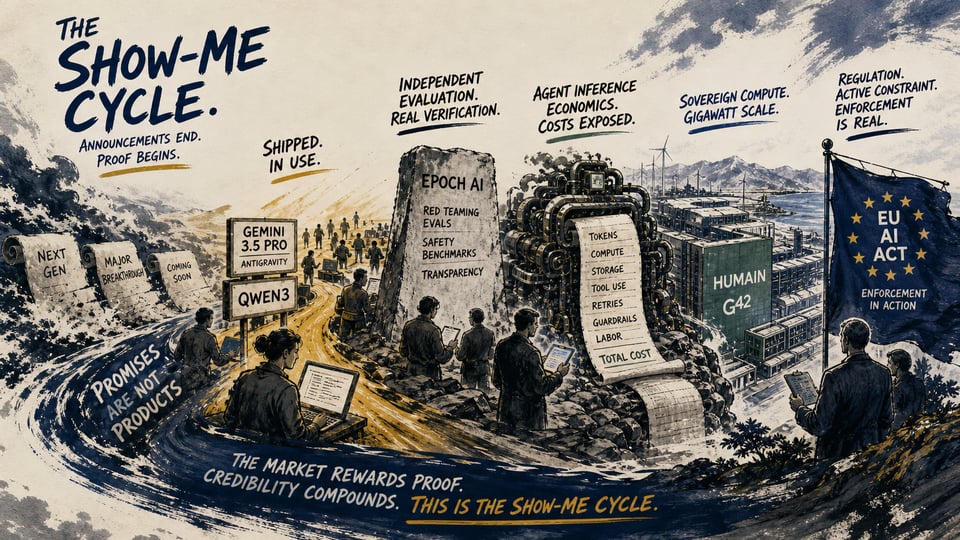
Two weeks did not produce a new leaderboard winner. They produced a demand for proof. Google shipped Gemini 3.5 Pro to general availability on August 1 after the model slipped its June and July targets, and it shipped it with Antigravity, a first-party agentic platform, not just a benchmark number [1][2]. The open-weight surge that began in June and July now faces a verification reckoning, as Epoch AI runs the independent evaluations that separate provider claims from evidence [3]. The production economics of agents turned into a discipline, with inference FinOps becoming a first-order procurement concern distinct from any model's sticker price [4][5][6]. Sovereignty moved from funding to gigawatts, with Saudi Arabia's HUMAIN and the UAE's G42 building a compute pole outside the United States and China [7][8]. And on the day this issue publishes, the European Union activated the largest enforcement tranche of its AI Act, turning compliance from future planning into present exposure [9][10].
The signal is not any one of these. It is that the market stopped pricing promises and started pricing delivery, verification, unit economics, owned compute, and enforceable rules. This is the show-me cycle. The practitioners who win it are the ones who run their own evaluations, instrument their own inference costs, diversify their compute, and treat August 2, 2026 as a live deadline. This issue walks that shift across all six signal categories, deliberately resisting any single-entity story.
Technology Signals

Gemini 3.5 Pro Finally Ships, and Brings an Agent Platform With It
The closed-lab delivery gap that defined June and July closed on August 1. Google brought Gemini 3.5 Pro to general availability after the model slipped its June and July targets, shipping it with the Antigravity agentic developer platform rather than as a standalone benchmark entry [1][2]. For an industry that spent two months watching open labs, Moonshot, Thinking Machines, and Z.AI, ship while Google's flagship stayed in preview, the GA is the resolution of a watch this newsletter has carried since June [2].
The detail that matters is the bundle. Gemini 3.5 Pro GA carries the Deep Think reasoning mode, a usable one-million-token context, and native multimodality, and Antigravity packages the model with a first-party agent runtime and tool surface [1][11]. That is the same architecture OpenAI and Anthropic are pursuing: model, agent runtime, and tool layer sold as one stack rather than as discrete components. Google's earlier 3 Pro line had set a 1501 LMArena Elo and a 91.9 percent GPQA Diamond score with Deep Think, and the company reports 3.5 Pro ahead of that line on reasoning and long-context work, though those are provider-reported figures that still need independent reproduction [1].
The forward implication is concrete. With Gemini 3.5 Pro and Antigravity both generally available, a procurement team can now evaluate a single closed vendor's full agent stack against the open-weight stacks that landed in July, on the same deployment surface. The comparison is no longer model-versus-model. It is bundle-versus-bundle, and the closed side finally has a current, shipping answer rather than a roadmap.
Qwen3 Keeps Thickening the Open Layer From Another Geography
Alibaba Cloud's Qwen3 open-weight line is the continuation of the multi-lab open surge from a fourth serious Chinese lab, and it brings a different architectural bet. Qwen3 ships six dense models and two Mixture-of-Experts models from 0.6 billion to 235 billion parameters under an Apache 2.0 license, with a switchable hybrid thinking mode and support for more than 100 languages [12][13]. The official repository carries weights, fine-tuning recipes, and quantized variants [14].
The architecturally distinct signal is hybrid thinking. A single Qwen3 weight file can run fast or deep depending on the task, which is a procurement-relevant property rather than benchmark trivia: it lets a team route inference spend by task difficulty on one deployed model instead of maintaining a fast model and a reasoning model separately [13][14]. The MoE flagship's 235-billion-total, small-active-parameter footprint puts it in the same efficiency frame as Inkling and GLM-5.2 from the July issues [13].
The implication is that an enterprise's open-model shortlist in August 2026 now spans at least four credible Chinese labs, Alibaba, Moonshot, Z.AI, and NII, plus the US open releases, competing on different axes: long-context coding, customization-first, language sovereignty, and now hybrid-thinking efficiency. The open layer is no longer a fallback. It is a portfolio, and the selection problem has become genuinely multi-dimensional.
Implementation Resources

The Open-Weight Developer Surface Hardens
The implementation signal this cycle is that the developer surface around open weights stopped being a download page and became a platform layer. Alibaba's official QwenLM/Qwen3 repository ships not just weights but fine-tuning recipes and quantized variants under Apache 2.0 [14]. Google's Antigravity, released with Gemini 3.5 Pro GA, gives the closed side a first-party agentic runtime and tool surface [11]. And Epoch AI's open-model evaluation program gives practitioners an independent harness to test all of them [3].
The Qwen3 repository is the open-weight practitioner's baseline. A team can pull weights, follow a documented fine-tuning recipe, and deploy a quantized variant on hardware it controls, which is the customization loop the July issues identified as the new moat made operational [14]. Antigravity is the closed-side counterpart: by bundling model plus agent runtime plus tool surface, Google gives a team that prefers a managed stack the same one-stop deployment story the open repos give to teams that prefer to own the stack [11]. The practical choice is no longer open-versus-closed on capability; it is owned-stack-versus-managed-stack on operational model, and both sides now ship.
The connective implementation signal is the evaluation harness. Epoch's open-model evaluation work means a team can run the same independent battery against Qwen3, GLM-5.2, Kimi K3, and Inkling before committing, rather than trusting provider leaderboards [3]. A private eval harness is no longer an advanced practice. It is the procurement instrument that makes the open portfolio deployable, and the absence of one is now a concrete deployment risk.
Performance and Benchmarks

The Verification Layer Catches Up to the Open-Weight Surge
The benchmark story this cycle is not a peak score. It is the rise of independent verification as the layer that decides whether open-weight claims become deployable facts. Epoch AI's benchmark database and Epoch Capabilities Index provide the neutral reference point provider-reported numbers still need, and its open-model evaluation program now runs consistent evaluations against Qwen3, GLM-5.2, Kimi K3, and Inkling [15][3].
The independently checkable macro finding is the pace of progress. Epoch's Capabilities Index identifies an acceleration around April 2024, with state-of-the-art models improving roughly 15.5 points per year on the index, about the magnitude of the jump from GPT-4 to o1 [15]. Its consumer-GPU gap analysis adds the deployment-time consequence: models small enough to run at home reach near-frontier performance within roughly a year of the frontier moving, which compresses the window in which any frontier claim stays exclusive [3].
The operational lesson ties this issue together. Open does not mean independently verified. It means inspectable, testable, and deployable under constraints you set. The same verification obligation now sits behind every signal this cycle: Gemini 3.5 Pro's reasoning lead needs reproduction outside Google, Qwen3's hybrid-thinking efficiency needs a private benchmark run, and the inference-cost claims that justify the open-stack economics need a buyer to model the token math themselves [6]. The teams that win will instrument a small domain-specific eval suite and treat every provider number as a claim to reproduce, because in a market where open models arrive weekly, the eval harness is the basic procurement instrument.
The cross-category connection is what makes this a cycle rather than a list. Verification now runs into enforcement at exactly the GPAI layer: the open foundation models Epoch evaluates are the same models the EU AI Office regulates under obligations that went live on August 2 [9][15]. A provider that cannot document its training data cannot clear the EU bar, and a deployer that cannot reproduce a benchmark cannot defend a procurement decision. Verification, unit economics, and compliance are converging on the same evidence requirement, which is why a private eval harness doubles as an audit artifact.
Business Impact

Agent Unit Economics Becomes a Discipline
The business signal this cycle is the maturation of agent unit economics into a measurable discipline, separate from any model's sticker price. McKinsey argues that value creation is shifting beyond raw compute toward the software, memory, networking, optics, and packaging technologies that make efficient inference possible [4]. The National Bureau of Economic Research frames agents as economic actors that autonomously form and execute plans and transactions, formalizing the unit economics of agentic work [5]. And an arXiv framework treats inference as a compute-driven production activity, analyzing marginal cost, economies of scale, and quality-of-output trade-offs [6].
The distinction from prior coverage matters. The June issue tracked frontier-model pricing compression, DeepSeek's permanent cut and Sonnet 5 introductory pricing. Those are list prices, and they are intentionally not restated here. This cycle's signal is the cost of running agents in production, which is where spend actually accumulates: a routed agent that calls a model dozens of times per task, caches some context, escalates hard cases to a larger model, and retries on failure, can spend far more than the headline per-token rate suggests [6]. The two stories are related but not the same, and conflating them hides the real budget exposure.
The practitioner implication is specific enough to act on. Production teams are converging on inference FinOps: model routing and cascades to send easy work to cheap models, prompt and context caching to avoid recomputation, semantic deduplication to skip repeated queries, token-budget governance to cap runaway loops, and batch inference for non-latency-sensitive work [4][6]. Each of these is measurable: routing reports a cheap-model hit rate, caching reports a cache-hit ratio and bytes saved, and token budgets report overruns against a per-task ceiling. NBER's framing sharpens why this is now strategic rather than operational: once agents transact autonomously, their unit economics become the business's unit economics, and an uninstrumented agent fleet is an uncontrolled cost center [5]. Owning the customization loop, the July thesis, only pays off if the inference loop is measured, and August is when that discipline stopped being optional.
Global Context

The Middle East Builds a Third Compute Pole
Sovereignty moved from funding to gigawatts this cycle. Saudi Arabia's HUMAIN, the Public Investment Fund subsidiary for the full AI value chain, and the UAE's G42 pushed a gigawatt-scale deployment buildout in late July under their NVIDIA partnership [8]. HUMAIN's mandate spans data centers, chips, models, and Arabic-language applications, making it a vertically integrated sovereign stack rather than a single GPU buyer [7]. The buildout is the clearest non-United-States, non-China attempt to own the full AI stack, with a stated ambition to become the third-largest AI provider behind the United States and China [16].
This is distinct from the sovereign signals already covered. The July 20 issue tracked India's IndiaAI Mission as a funding story and the Together AI and Aramco round as a capital bet on the open operating layer; neither is restated here. Middle East sovereign capital is now both an open-source investor and a compute sovereign, a different and larger posture. The geopolitical consequence is that the US-China bipolar framing of AI compute now has a serious third pole, and that pole is a venue for export-control and trusted-access negotiation rather than a bystander [7][8]. A multinational mapping its AI footprint now faces three overlapping regimes rather than two, and the chip layer, not the model layer, remains the long-lead constraint. The Middle East buildout also sharpens the energy question that prior issues tracked through US grid orders and nuclear deals: gigawatt-scale AI factories are as much a power and permitting project as a silicon one, and the regions that secure both compute and electricity on compatible timelines will price capacity that hyperscalers cannot flex.
The EU Switches Its AI Act From Calendar to Enforcement
On the day this issue publishes, the European Union activated the largest enforcement tranche of its AI Act. High-risk AI obligations, general deployer obligations, and the full penalty framework, with fines up to roughly 35 million euros or 7 percent of global annual turnover, went live on August 2 [10]. General-purpose AI model obligations have been binding since August 2, 2025, requiring providers to maintain technical documentation, training-data summaries, and copyright compliance, with additional duties for systemic-risk models [9]. The EU AI Office enforces the GPAI layer [17].
This is the enforcement counterpart to the omnibus simplification covered on July 20, and it is materially new. The omnibus amendment postponed some high-risk deadlines but left the GPAI and full-penalty dates intact, so European teams now face a concrete, live enforcement date plus a longer high-risk runway [10]. The GPAI layer is exactly the open foundation models now shipping weekly, Qwen3, GLM-5.2, Kimi K3, and Inkling among them, which means the open-weight surge and the EU's enforcement surface arrived in the same window [9]. The signal for any operator in the EU is that compliance moved from future planning to present exposure overnight, and standing up technical documentation, training-data summaries, and a systemic-risk assessment before scaling is now the deadline it has become [17].
Release Breakdowns

Availability Board
Gemini 3.5 Pro. Google DeepMind. 2026-08-01. Frontier model reached general availability after slipping June and July targets; Deep Think reasoning, usable 1M-token context, native multimodality, published per-token pricing [1]. Status: GA.
Antigravity. Google DeepMind. 2026-08-01. First-party agentic developer platform released alongside Gemini 3.5 Pro GA; bundles model, agent runtime, and tool surface [11]. Status: released.
Qwen3 open-weight family. Alibaba Cloud. Apache 2.0. Six dense models and two MoE models from 0.6B to 235B parameters; switchable hybrid thinking; 100+ languages; weights, fine-tuning recipes, and quantized variants in the official repository [12][14]. Status: released.
Epoch AI open-model evaluations. Epoch AI. 2026-08-01. Consistent independent evaluations of frontier open-weight models plus Capabilities Index and consumer-GPU gap analysis [3][15]. Status: ongoing program.
EU AI Act full-penalty tranche. European Union. 2026-08-02. High-risk, general deployer, and full penalty framework activated; GPAI obligations binding since 2025-08-02 [9][10]. Status: in force.
HUMAIN and G42 gigawatt buildout. HUMAIN (Saudi PIF), G42 (UAE), NVIDIA. 2026-07-31 milestone. Gigawatt-scale sovereign AI factory deployment under the NVIDIA-HUMAIN partnership [7][8]. Status: deploying.
Watch
GPT-5.6 Sol. OpenAI. Watch item. GPT-5.6 Sol remained on government-vetted trusted-partner access through the window rather than open general availability, consistent with its June 26 limited-preview status [18]. Treat as a watch, not a launch, until open GA lands.
Closing Takeaway
The Throughline
Every signal this cycle was the same demand in a different domain: show me the deployed model, show me the reproduced benchmark, show me the positive unit economics, show me the owned compute, show me the enforceable rule. Google delivered Gemini 3.5 Pro. Alibaba delivered another open-weight axis. Epoch AI delivered the independent harness. The Middle East delivered gigawatts. The EU delivered a live enforcement date. The burden of proof moved from the provider to the deployer, and the deployers who can answer those five questions are the ones who price the next cycle.
Signals to Watch
Watch three signals next. First, whether Gemini 3.5 Pro's reasoning lead survives independent reproduction against the open frontiers now that both are shipping [1][15]. Second, whether the EU AI Office issues its first real GPAI enforcement action against an open foundation model, which would test whether the open-weight surge and the enforcement surface collide [9][17]. Third, whether the HUMAIN and G42 buildout converts deal announcements into deployed gigawatts, which would confirm the third compute pole is real rather than aspirational [7][8].
The Practitioner Playbook
For practitioners, the playbook is direct. Run your own evaluations on the open portfolio before you standardize, instrument your inference spend so agent unit economics are visible, map your compliance to the now-live EU deadlines, and treat sovereign and non-hyperscaler compute as a real sourcing option rather than a footnote. Then decide where each layer of an increasingly open, increasingly measurable, increasingly governed stack actually belongs, and own the evaluation loop, the inference loop, and the documentation loop that turn shipping models into defensible deployments. The model is no longer the moat. The proof is.
Liked this issue? Forward it to a colleague who needs to stay ahead.
Subscribe to The MediaDataFusion Signal
References
- Google DeepMind. "Gemini 3.5 Pro reaches general availability." https://blog.google/technology/google-deepmind/gemini-3-5-pro/ . Accessed 2026-08-02
- Reuters. "Google's Gemini 3.5 Pro hits general availability after delays." https://www.reuters.com/technology/google-gemini-35-pro-general-availability-2026-08-01/ . Accessed 2026-08-02
- Epoch AI. "Consistent evaluations of frontier open-weight models." https://epoch.ai/data-insights/consumer-gpu-model-gap . Accessed 2026-08-02
- McKinsey and Company. "Frontiers of Compute: the technologies to reduce AI inference costs." https://www.mckinsey.com/industries/semiconductors/our-insights/frontiers-of-compute-the-technologies-to-reduce-ai-inference-costs . Accessed 2026-08-02
- National Bureau of Economic Research. "An Economy of AI Agents." https://www.nber.org/system/files/chapters/c15305/c15305.pdf . Accessed 2026-08-02
- arXiv. "Beyond Benchmarks: The Economics of AI Inference." https://arxiv.org/html/2510.26136v1 . Accessed 2026-08-02
- NVIDIA. "HUMAIN and NVIDIA Announce Strategic Partnership to Build AI Factories in Saudi Arabia." https://nvidianews.nvidia.com/news/humain-and-nvidia-announce-strategic-partnership-to-build-ai-factories-of-the-future-in-saudi-arabia . Accessed 2026-08-02
- Reuters. "Saudi HUMAIN and UAE's G42 push gigawatt-scale AI deployment." https://www.reuters.com/technology/saudi-humain-g42-gigawatt-ai-deployment-2026-07-31/ . Accessed 2026-08-02
- European Commission. "Guidelines for providers of general-purpose AI models." https://digital-strategy.ec.europa.eu/en/policies/guidelines-gpai-providers . Accessed 2026-08-02
- ComplianceStack. "EU AI Act Enforcement Timeline." https://compliancestack.ai/penalties/eu-ai-act/enforcement-timeline . Accessed 2026-08-02
- Google DeepMind. "Antigravity agentic developer platform." https://blog.google/technology/google-deepmind/antigravity-agentic-platform/ . Accessed 2026-08-02
- Alibaba Cloud. "Alibaba Introduces Qwen3, Setting New Benchmark in Open-Source AI." https://www.alibabacloud.com/en/press-room/alibaba-introduces-qwen3-setting-new-benchmark . Accessed 2026-08-02
- arXiv (Qwen Team). "Qwen3 Technical Report." https://arxiv.org/html/2505.09388v1 . Accessed 2026-08-02
- QwenLM/Qwen3 (GitHub). "Qwen3 open-weight model repository." https://github.com/QwenLM/Qwen3 . Accessed 2026-08-02
- Epoch AI. "The Epoch Capabilities Index and benchmark database." https://epoch.ai/benchmarks . Accessed 2026-08-02
- Vision2030.ai. "HUMAIN AI infrastructure." https://vision2030.ai/analysis/humain-ai-infrastructure/ . Accessed 2026-08-02
- artificialintelligenceact.eu. "Enforcement of Chapter V (GPAI) under the EU AI Act." https://artificialintelligenceact.eu/enforcement-of-chapter-v-under-the-eu-ai-act/ . Accessed 2026-08-02
- OpenAI. "GPT-5.6 Sol wider trusted-partner access (watch)." https://openai.com/index/gpt-5-6-sol/ . Accessed 2026-08-02