The Export-Control Era Arrives
Introduction
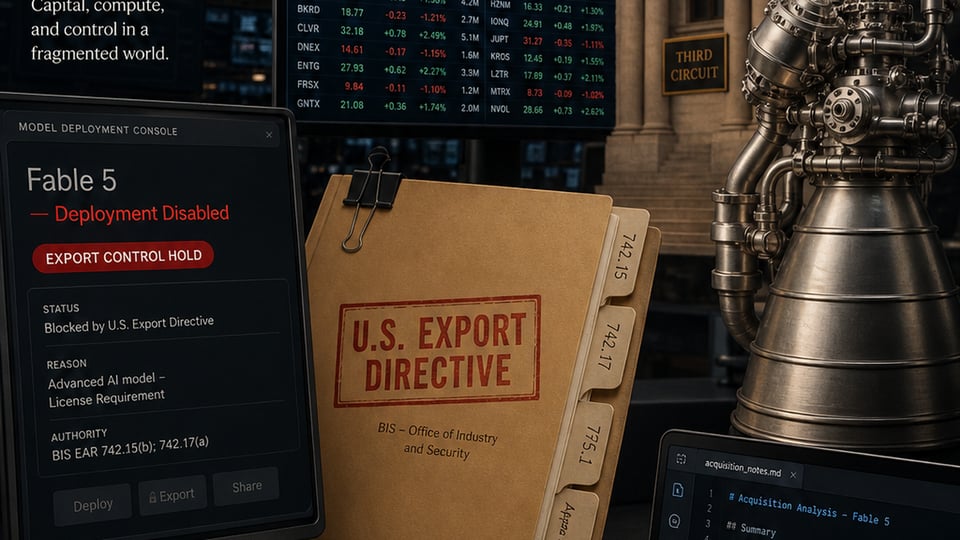
On June 9, Anthropic released Claude Fable 5, the most capable model it had ever made available to the public [1]. On June 12, the US government ordered it disabled [2]. An export control directive, citing national security authorities, required Anthropic to suspend all access to Fable 5 and its restricted sibling Mythos 5 by any foreign national, inside or outside the United States [2]. Because Anthropic could not comply selectively, it shut both models down for all customers [2].
Three days from launch to recall. That is the signal this issue tracks. The directive is the first time the US government has used export control authorities to pull a commercial AI model from the market [3]. It establishes that frontier models are now treated as strategic assets subject to state control, not consumer products.
The same two weeks compressed several structural shifts. SpaceX completed the largest initial public offering in history and immediately spent $60 billion to acquire the coding tool Cursor [4][5]. The Federal Energy Regulatory Commission ordered all six regional grid operators to fast-track data center connections [6]. The Third Circuit heard oral arguments in the first appellate case on AI training data fair use [7]. And Gemini 3.5 Pro, promised for June general availability, has still not shipped [8]. At the G7 summit in Evian, leaders turned the Anthropic access fight into a question of allied governance [3].
The story is no longer who has the best model. It is who controls the model, who controls the infrastructure, who owns the tooling, and which governments set the terms of access.
Technology Signals

Fable 5 Launches, Then the Government Intervenes
Anthropic released Claude Fable 5 on June 9 as the first Mythos-class model available to the general public [1]. Fable 5 is the same underlying model as Mythos 5, but with safeguards that redirect cybersecurity and biology queries to Claude Opus 4.8 [1]. The safeguards trigger in less than 5% of sessions on average [1]. Pricing was set at $10 per million input tokens and $50 per million output tokens, less than half the price of Claude Mythos Preview [1]. TechCrunch confirmed Fable 5 is the first Mythos variant the public can access [9]. Tech Times corroborated the public launch and the gated safeguard design [10].
The launch delivered on the "coming weeks" promise that the June 8 issue tracked. But three days later, at 5:21pm ET on June 12, the US government issued an export control directive [2]. Anthropic stated the directive ordered suspension of all foreign national access, citing national security [2]. The government cited a jailbreak method that could bypass Fable 5 safeguards to identify software vulnerabilities [2]. Anthropic reviewed the technique and found the vulnerabilities were "relatively simple" and discoverable by other publicly available models, including OpenAI's GPT-5.5 [2].
Anthropic did something unusual for a company facing a government directive: it publicly disagreed [2]. The company stated the government's standard "would essentially halt all new model deployments for all frontier model providers" if applied across the industry [2]. Anthropic called the action a misunderstanding and said it is working to restore access, but gave no timeline [2]. Access to all other Anthropic models, including Claude Opus 4.8, was not affected [2].
This is the first government-mandated recall of a commercial AI model. It establishes that any frontier model shipped to international users can be blocked by export controls at any time.
Gemini 3.5 Pro Has Not Shipped
Google announced Gemini 3.5 Pro at I/O on May 19 with a target of general availability in June [8]. As of June 18, the model remained in limited Vertex AI enterprise preview and was not generally available [8]. The model features a 2-million-token context window and a Deep Think reasoning mode [8].
The June 8 issue noted that Gemini 3.5 Pro had not yet launched publicly. Two weeks later, the status is unchanged. The competitive window that was supposed to feature a three-way contest between Anthropic, OpenAI, and Google has instead featured a suspended model and an unshipped one.
Business Impact

SpaceX Completes the Largest IPO in History
The June 8 issue covered the SpaceX S-1 filing targeting a $1.75 to $2 trillion valuation. The final pricing landed within that range and trading began on Nasdaq under ticker SPCX [4]. The public listing validated the market for vertically integrated AI conglomerates. Post-xAI merger, SpaceX is an AI infrastructure company: it owns the Colossus supercomputer, the Starlink distribution network, and now a public currency for acquisitions.
The significance is structural, not a product release. A company that controls launch capacity, satellite distribution, and frontier compute now has a public equity instrument it can use to absorb adjacent businesses.
SpaceX Acquires Cursor for $60 Billion
Days after the IPO, SpaceX signed a definitive agreement to acquire Anysphere, the company behind the AI coding tool Cursor, for $60 billion in an all-stock transaction [4]. CBS News confirmed the timing, the wholly owned subsidiary structure, and the third-quarter 2026 closing target [5].
The June 8 issue reported the Cursor acquisition as an option disclosed in the S-1. SpaceX exercised it. The deal gives SpaceX control of both the hardware, through Colossus, and the developer tooling, through Cursor [4][5].
Independent AI coding tools are disappearing into larger platforms. The most important coding surfaces are now controlled by different types of companies: a rocket and AI conglomerate, a cloud platform, and a model lab. Practitioners who built workflows around independent tools now face platform lock-in risk. Enterprise buyers should treat developer-tool ownership as a procurement risk, because roadmap control, model routing, and data handling can change after acquisition.
Global Context

Export Controls Reach Frontier AI
The June 12 directive against Fable 5 and Mythos 5 is the first use of export control authorities to recall a commercial AI model [2][3]. Export controls have previously targeted chips, such as restrictions on advanced accelerators. Applying them to a general-purpose language model establishes a new precedent: any frontier model can be treated as a controlled technology [2].
The June 8 issue covered the executive order that established a voluntary framework for government collaboration on AI security. The export control directive goes beyond voluntary collaboration into mandatory restriction, issued under the same administration. The dual posture is striking. The government signed a voluntary framework and then used mandatory controls three days after a model launch.
G7 Evian Turns the Access Fight Into an Allied Question
At the G7 summit in Evian, leaders made the Anthropic access fight an allied-governance problem rather than a purely American one. The official summit outcomes list digital and artificial intelligence among the major shared challenges, with members working alongside leading companies on safe and beneficial AI deployment [3]. The leaders' statement on growth references the rapid advancement of frontier AI model capabilities and asks finance ministers, central-bank governors, financial supervisors, global institutions, and technology companies to discuss AI risks and opportunities [11]. The official day-three schedule confirms a working lunch on safe, rapid, and effective AI deployment with G7 countries, partner countries, and business leaders [12].
WION reported that the G7 discussed a trusted-partners framework for selective allied access to advanced US models after the Anthropic export ban, with US Commerce Secretary Howard Lutnick and European diplomats involved [13]. The G7 Research Group described the Mythos capability and the US access ban as a shock that forced leaders to reconsider how allied AI governance should work [14]. A separate G7 declaration on critical minerals connects arbitrary export restrictions, dual-use controls, and technology-control coordination to the broader supply-chain picture [15].
The likely policy middle ground is neither open access nor blanket recall. It is trusted allied access under explicit controls, tied to identity, jurisdiction, and use case [13].
FERC Orders Grid Operators to Fast-Track Data Centers
On June 18, FERC issued six tailored orders directing all six regional grid operators to justify or reform their tariffs for data centers and other large energy users [6]. TechCrunch noted that FERC gave data centers a government-mandated fast lane to the grid but did not address electricity supply shortages [6]. The American Action Forum analyzed the orders as using Section 206 of the Federal Power Act, giving grid operators 60 days to justify or overhaul interconnection processes [16]. Tech Times confirmed the orders took effect immediately and addressed cost allocation for ratepayers [17].
The action is the federal government removing infrastructure bottlenecks to AI growth. The same week the government restricted model access through export controls, it enabled data center growth through grid mandates. Restrict the model, accelerate the infrastructure. That is the current regulatory posture.
Third Circuit Hears First Appellate Fair-Use Case
The Third Circuit Court of Appeals heard oral arguments in Thomson Reuters Enterprise Centre v. Ross Intelligence, the first appellate case on AI training data fair use [7]. World Trademark Review reported that opposing counsel sparred over transformative use and market harm [7]. The June 8 issue noted the arguments were scheduled. This issue confirms they were held. The appellate ruling will set binding precedent for how courts analyze AI training data across the Third Circuit. It is a secondary signal in this issue, not the lead, but it matters because training-data law now moves in parallel with access-control law.
Release Breakdowns

Claude Fable 5
Provider: Anthropic. Date: June 9. Type: frontier proprietary, Mythos-class public release.
What changed: the first public Mythos-class model, with safeguards that redirect cybersecurity and biology queries to Claude Opus 4.8. Pricing at $10/$50 per million tokens. This delivered the "coming weeks" promise tracked in the June 8 issue [1][9].
Status: suspended for all customers since June 12 under the US export control directive [2].
Claude Mythos 5
Provider: Anthropic. Date: June 9. Type: restricted Mythos-class, Glasswing-only.
What changed: the same model as Fable 5 with safeguards lifted for approved cyber defenders and infrastructure providers through Project Glasswing [1].
Status: suspended for all customers since June 12 under the same export control directive [2].
Gemini 3.5 Pro
Provider: Google DeepMind. Date: announced May 19, not yet generally available. Type: frontier proprietary.
What changed: nothing since the June 8 issue. The model remained in limited Vertex AI preview as of June 18, with a 2-million-token context window and Deep Think mode announced but benchmarks and pricing unpublished [8].
Status: not generally available. Google missed its June target.
Implementation Resources

Model-access fallback. If workflows depend on Fable 5 or Mythos 5, migrate to Claude Opus 4.8 [2]. Anthropic designed Fable 5 to redirect safeguarded queries to Opus 4.8 anyway [1]. Do not assume quick restoration. Anthropic gave no timeline [2]. Build multi-model fallbacks into production. Any frontier model can now be subject to export control suspension, and the G7 trusted-partners discussions imply future enterprise access may require stronger identity, jurisdiction, logging, and use-case controls [13].
Power readiness. Expect faster interconnection timelines for data center capacity after the FERC orders [6][16][17]. But faster connections do not mean more power is available [6]. Continue planning behind-the-meter generation, battery storage, and nuclear power purchase agreements. Ratepayer cost allocation rules may change after the 60-day review window [16].
Developer-tool risk. SpaceX acquired Cursor for $60 billion with a third-quarter 2026 close [4][5]. Monitor for changes to pricing, data policies, or xAI ecosystem integration. Maintain a migration register for development tools, not just for models.
Operating checklist. Map workflows to models and regions. Define fallback models by task, not only by vendor. Record the expected quality loss and security differences for each fallback. Separate cyber-defense access from general employee access. Track data-retention changes for high-capability models. Add power readiness and interconnection risk to AI infrastructure planning.
Performance and Benchmarks

Benchmark Claims Frozen at Launch
Anthropic stated Fable 5 is state-of-the-art on nearly all tested benchmarks, with strong results in software engineering, vision, long-context behavior, memory, and science [1]. TechCrunch reported early customer signals, including third-party benchmark comments, but these remain early customer examples rather than broad independent evaluation [9]. All of the headline claims come from Anthropic's own announcement and customer testimonials.
The benchmark claims cannot be independently verified. Fable 5 was available for approximately three days before suspension. No independent benchmarking organization had time to test it. The performance story is now locked at launch values, with no way to reproduce or extend it.
The Verification Gap Widens
The June 8 issue identified a concentration of self-reported benchmark claims. This issue extends the pattern. Fable 5 shipped with Anthropic's claims and was suspended before independent testing [1][2]. Gemini 3.5 Pro, which would provide a competitive comparison point, has not shipped [8]. The gap between claimed and verified performance is widening at the exact moment when governments are making regulatory decisions based on model capabilities.
The export control directive cited Fable 5's cybersecurity capabilities [2]. Those capabilities were assessed by the government, not by an independent evaluation body [2]. If regulatory decisions rest on vendor-reported or government-assessed capabilities rather than transparent benchmarks, the governance framework will be built on claims that no one can reproduce.
Closing Takeaway
The export-control era is here. The signal of these two weeks is that frontier AI capability is no longer governed only by release cadence and benchmark scores. It is governed by who controls access, who controls the infrastructure, who owns the tooling, and which governments set the terms.
The June 12 directive against Fable 5 and Mythos 5 is the first recall of a commercial AI model by export control [2][3]. The G7 turned that recall into an allied question about trusted access [3][11][13]. SpaceX used public-market capital to consolidate the leading independent coding tool [4][5]. FERC ordered grid operators to clear the path for data centers [6][16][17]. And Gemini 3.5 Pro, the model that was supposed to reset the benchmark race, still has not shipped [8].
Watch for three signals in the next two weeks. First, whether Anthropic restores Fable 5 and Mythos 5 access, and under what conditions the government allows it [2]. Second, whether the export control precedent triggers similar actions against other frontier models, particularly those with international user bases. Third, whether the G7 trusted-partners framework produces a concrete allied-access model [13].
For practitioners, the implication is structural. Multi-model fallback is no longer a best practice. It is a regulatory hedge. Build on open weights where you can. Verify every benchmark claim independently, or accept that you cannot. And assume that any frontier model you depend on can be suspended by government directive at any time.
Liked this issue? Forward it to a colleague who needs to stay ahead.
Subscribe to The MediaDataFusion Signal
References
- Anthropic. "Claude Fable 5 and Claude Mythos 5". https://www.anthropic.com/news/claude-fable-5-mythos-5. Accessed 2026-06-22
- Anthropic. "Statement on the US government directive to suspend access to Fable 5 and Mythos 5". https://www.anthropic.com/news/fable-mythos-access. Accessed 2026-06-22
- Elysee / G7 France. "The outcomes of the Evian G7 Summit". https://www.elysee.fr/en/G7evian/2026/06/17/the-outcomes-of-the-evian-g7-summit. Accessed 2026-06-22
- TechCrunch. "SpaceX to acquire Cursor for $60B in stock, days after blockbuster IPO". https://techcrunch.com/2026/06/16/spacex-to-acquire-cursor-for-60b-in-stock-days-after-blockbuster-ipo/. Accessed 2026-06-22
- CBS News. "SpaceX to buy AI coding assistant Cursor for $60 billion". https://www.cbsnews.com/news/spacex-cursor-60-billion-ai-acquisition/. Accessed 2026-06-22
- TechCrunch. "AI data centers just got a government-mandated fast lane to the grid". https://techcrunch.com/2026/06/18/ai-data-centers-just-got-a-government-mandated-fast-lane-to-the-grid/. Accessed 2026-06-22
- World Trademark Review. "Third Circuit weighs transformational AI training claims in Thomson Reuters v ROSS Intelligence appeal". https://www.worldtrademarkreview.com/article/third-circuit-weighs-spectacularly-transformational-ai-training-claims-in-landmark-thomson-reuters-v-ross-intelligence-appeal. Accessed 2026-06-22
- The AI Rankings. "Gemini 3.5 Pro: 2M Context, Deep Think and Release Status". https://theairankings.com/google/gemini-3-5-pro/. Accessed 2026-06-22
- TechCrunch. "Anthropic's Claude Fable 5 is a version of Mythos the public can access today". https://techcrunch.com/2026/06/09/anthropics-claude-fable-5-is-a-version-of-mythos-the-public-can-access-today/. Accessed 2026-06-22
- Tech Times. "Anthropic Launches Claude Fable 5: Most Powerful Public Model, Gated by Safeguards". https://www.techtimes.com/articles/318082/20260609/anthropic-launches-claude-fable-5-most-powerful-public-model-gated-safeguards.htm. Accessed 2026-06-22
- Elysee / G7 France. "Leaders' statement for a more balanced, durable, resilient growth". https://www.elysee.fr/en/G7evian/2026/06/17/leaders-statement-for-a-more-balanced-durable-resilient-growth. Accessed 2026-06-22
- Elysee. "G7 Summit in Evian: Day Three". https://www.elysee.fr/en/emmanuel-macron/2026/06/17/g7-summit-in-evian-day-three. Accessed 2026-06-22
- WION. "AI at G7: Trusted partners plan being discussed amid US export ban on Anthropic's AI models". https://www.wionews.com/world/ai-at-g7-trusted-partners-plan-being-discussed-amid-us-export-ban-on-anthropics-ai-models-1781671577777. Accessed 2026-06-22
- G7 Research Group, University of Toronto. "G7 Leaders-CEOs Cooperative AI Governance". https://www.g7.utoronto.ca/evaluations/2026evian/kirton-ai-governance.html. Accessed 2026-06-22
- Elysee / G7 France. "G7 leaders' declaration on securing supply chains for critical minerals". https://www.elysee.fr/en/G7evian/2026/06/17/g7-leaders-declaration-on-securing-supply-chains-for-critical-minerals. Accessed 2026-06-22
- American Action Forum. "FERC Data Center Orders Accelerate Grid Connection". https://www.americanactionforum.org/insight/ferc-data-center-orders-accelerate-grid-connection/. Accessed 2026-06-22
- Tech Times. "FERC Mandates Fast-Track Data Center Grid Access, Shielding Ratepayers from Costs". https://www.techtimes.com/articles/318755/20260620/ferc-mandates-fast-track-data-center-grid-access-shielding-ratepayers-costs.htm. Accessed 2026-06-22