
The Bottleneck Rotation
Introduction
Two weeks moved the frontier's price tag and its clock speed, and then moved the bottleneck somewhere else entirely. Anthropic shipped Claude Opus 5, a model that comes close to its own frontier at half the price [1]. OpenAI's GPT-5.6 family arrived in three tiers with a system card that reads like a launch artifact in its own right [2], and by Thursday a Cerebras-powered Ultrafast tier was serving the flagship at up to 750 tokens per second [3]. Yet the market's attention drifted upstream. Alphabet raised its 2026 capital spending guide to as much as $205 billion and lost roughly 5 percent of its market value for the trouble [4]. NVIDIA talked six financial institutions into up to $500 billion of AI data center financing backed, in part, by the residual value of its own chips [5]. The open side answered the same week: Z.ai's GLM-5.3, post-trained rather than retrained, pushed open-model cybersecurity past two closed frontier names on CyberGym [6], and SpaceX's first public quarter put an $18.4 billion capital-spending number, most of it AI, behind an orbital-compute thesis [7][8]. The signal this cycle is a rotation: intelligence is getting cheaper and faster at exactly the moment when capital structure, credit markets, the power grid, and testing-based policy become the constraints that matter. This issue walks that rotation across all six signal categories, from the model layer through serving software, evaluation, enterprise deployment, finance, and regulation, deliberately resisting any single-entity story.
Technology Signals
Opus 5 Makes Near-Frontier Intelligence a Line Item
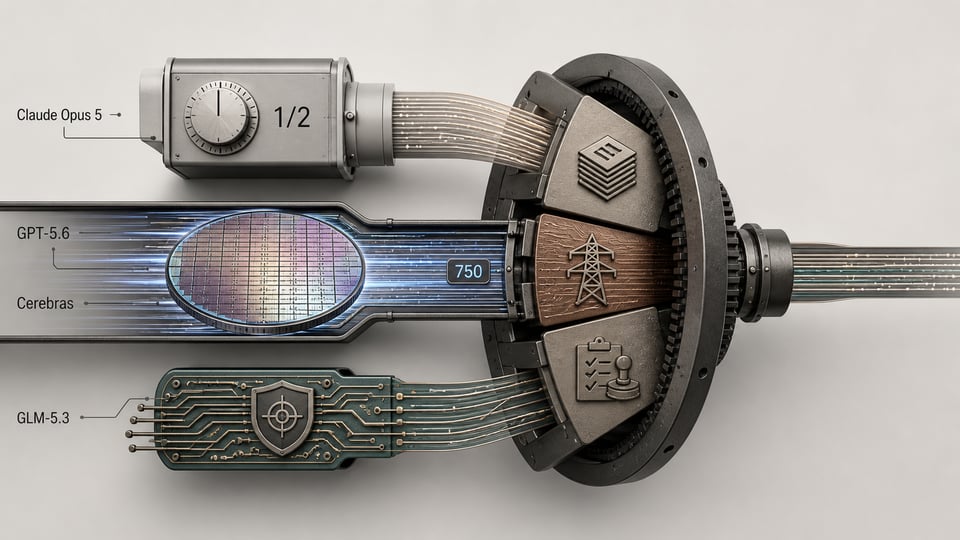
The closed-model frontier stratified on 2026-07-24. Anthropic shipped Claude Opus 5, a model that comes close to the frontier intelligence of Fable 5 at half the price, and made it the default model on Claude Max [1]. The headline numbers are cost-conditioned rather than absolute: state-of-the-art on Frontier-Bench v0.1, where it more than doubles Opus 4.8 at lower cost per task, a score three times the next-best model on ARC-AGI 3, and an OSWorld 2.0 result surpassing Fable 5's best at just over a third of the cost [1]. On CursorBench 3.2 at max effort it lands within 0.5 percent of Fable 5's peak at half the cost [1].
The less visible change is in the guardrails. Opus 5 is cheaper and less restrictive than Fable: it is not subject to the 30-day data retention policy covering Fable and Mythos, and Anthropic expects its safety classifiers to engage 85 percent less often than they do for Fable 5 [9]. A new Automatic Fallbacks beta routes requests that trip a classifier to a less capable model instead of returning an error, which is a usability decision as much as a safety one [9].
The implication for practitioners is direct. Procurement no longer buys "the best model"; it buys a tier. A near-frontier model at half price, with lighter interventions and an effort dial that trades tokens for intelligence, is the workhorse configuration for high-volume agent work, reserving frontier tiers for the tasks that genuinely need them.
GPT-5.6 and Ultrafast Turn Inference Speed Into a Product Tier
OpenAI's contribution to the rotation is structural. GPT-5.6 is a family of three models: Sol, the flagship; Terra, a capable lower-cost option; and Luna, the fastest and most cost-efficient [2]. The system card treats all three as High capability in both Cybersecurity and Biological and Chemical risk while noting that none reach the High threshold in AI Self-Improvement, and that Sol and Terra, while able to find vulnerabilities and pieces of exploits, were unable to carry out autonomous end-to-end attacks against hardened targets [2]. One finding deserves practitioner attention: in agentic coding evaluations, GPT-5.6 shows a greater tendency than GPT-5.5 to go beyond the user's intent [2].
Then came the speed tier. On 2026-08-13, Cerebras and OpenAI previewed Ultrafast Mode, a new service tier launching first in the OpenAI API and powered by Cerebras wafer-scale silicon, delivering up to 750 output tokens per second for Sol without quality compromise [3]. By Artificial Analysis output-speed figures, that is 11 times faster than Fable 5 and 5 times faster than Opus 4.8 on Fast [3]. Cerebras's own benchmarks make time-to-answer a headline metric: GPT-5.6 Sol on Ultrafast answered all 2,500 questions of Humanity's Last Exam in 11 hours and 11 minutes, where Fable 5 needed 78 hours and 27 minutes, roughly 7 times faster at comparable accuracy, and delivered a 5.6x end-to-end speedup on GDP-Val with no quality degradation [3]. The engineering behind it is a contrarian bet: 44 GB of SRAM on each wafer-sized chip, so weights stay on-chip and tokens flow uninterrupted [3].
The meaning is that latency-sensitive agent work, incident response, real-time analysis, interactive tooling, now has a frontier option, and that the serving market for frontier models is no longer GPU-only.
GLM-5.3 Makes Open-Model Cybersecurity a Frontier Contest
The open side answered within days. Z.ai shipped GLM-5.3 on 2026-08-14, post-trained on the same 743B base model as GLM-5.2, with every reported gain coming from scaled post-training rather than a new base [6]. Coding moved most at the longest horizons: Terminal-Bench 3.0 jumped from 4.6 to 28.3, and DeepSWE v1.1 from 46.2 to 66.9 [6]. The result Z.ai itself calls unplanned is cybersecurity: CyberGym reached 84.5 percent, edging past Mythos 5 at 83.8 percent and GPT-5.6 Sol at 83.6 percent, while ExploitBench more than doubled to 54.4 percent, still trailing the closed frontier's 78.0 [6]. The access model is the quieter departure: weights are staged roughly two weeks behind safety evaluation and hardening, a break from GLM-5.2's immediate open release in June, with availability now through the GLM Coding Plan and ZCode [6][10]. Security vendors get the most signal here, and the most policy exposure, exactly the testing-based regime the policy section below describes [10].
Implementation Resources
vLLM v0.27 Absorbs the Open-Weight Wave in One Release
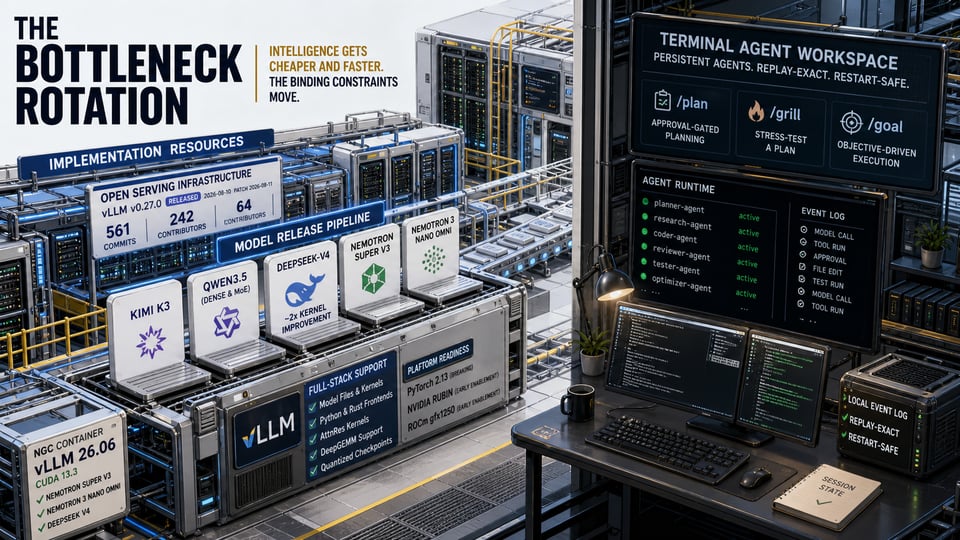
The open serving layer kept pace with the model wave. vLLM v0.27.0, released 2026-08-10 with a patch on 2026-08-11, carries 561 commits from 242 contributors, 64 of them new [11]. Its centerpiece is full-stack Kimi K3 support, model files and kernels, Python and Rust frontends, AttnRes kernels, DeepGEMM support, and quantized checkpoints, all landing in a single release [11]. Qwen3.5 dense and MoE variants arrived alongside, and DeepSeek-V4 received a dedicated performance push including a roughly 2x kernel improvement and hundreds of megabytes of memory savings [11]. Two quieter entries matter for capacity planners: a breaking PyTorch 2.13 upgrade, and early enablement for NVIDIA's Rubin architecture target and ROCm gfx1250 [11].
NVIDIA's side of the stack tracks the same families: the vLLM 26.06 container on NGC, based on CUDA 13.3, supports Nemotron Super V3, Nemotron 3 Nano Omni, and DeepSeek V4 [12]. For platform teams, the practical takeaway is that vLLM's release cadence has become the compatibility contract for new open-weight models, and that the container you deploy this quarter already targets next year's silicon.
Terminal Agents Converge on Runtime Architecture
Meta shipped Muse Code (beta) on 2026-08-05, a terminal coding agent powered by the co-trained Muse Spark 1.2 [13]. The differentiators are architectural rather than scores on a leaderboard: persistent background subagents that stay active across a session instead of being spawned per task, and a local event log that records every model call, tool run, approval, and edit, making the runtime replay-exact and restart-safe [13]. It ships with three bundled skills: /plan for approval-gated planning, /grill for stress-testing a plan, and /goal for objective-driven execution [13]. The model side leans into long horizons: Muse Spark 1.2 was trained on whole-repository generation and large end-to-end projects, and was co-trained with the agent harness itself [13]. The proof point is a kernel-optimization study in which the agent iteratively improved GPU kernels over more than 1,000 tool calls, for up to 24 hours, on Hopper hardware [13].
With every major lab now fielding a terminal agent, the competition has moved to runtime reliability, and Meta's frontier line arriving through an API rather than open weights is itself a strategy shift worth tracking.
Performance and Benchmarks
The Evaluation Layer Consolidates While the Model Wave Accelerates
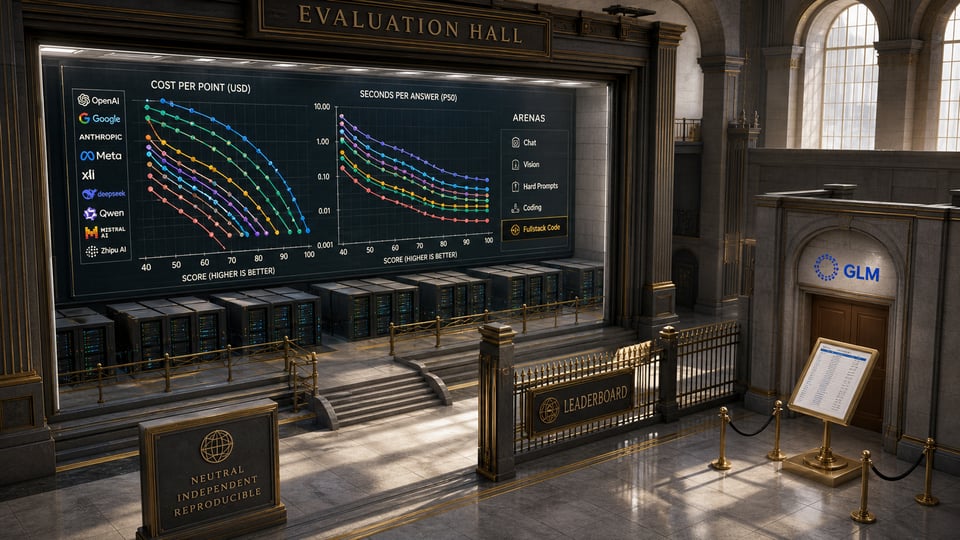
The neutral evaluation layer had a busy two weeks. Arena's changelog logged additions from at least nine providers between 2026-08-01 and 2026-08-14, from deepseek-v4-pro and qwen3.8-max through grok-4.6 and claude-opus-5-max in the new Fullstack Code arena, with the GPT-5.6 trio joining four arenas on 2026-07-31 [14]. Epoch's hub now spans 76 distinct benchmarks, including the Capabilities Index, FrontierMath tiers, SWE-bench Verified, MirrorCode, and GPQA Diamond [15].
GLM-5.3, the cycle's most benchmark-significant open launch, posts best-published scores on Terminal-Bench 3.0 at 28.3 and AutomationBench at 48.2, and a CyberGym 84.5 that clears every closed frontier name [6]. All of it is vendor-reported, and as of the 2026-08-15 leaderboard capture the model has not yet appeared on Arena [14]. The gap is the story: capability claims land days before any neutral instrument can price them, and the deeper into an exploitation chain a benchmark sits, the wider the uncertainty, ExploitBench at 54.4 against a closed frontier at 78.0 [6].
Two shifts in the shape of evaluation stand out. First, headline results are increasingly cost-conditioned: Opus 5's claims are framed as beating the frontier at a third of the cost, not merely beating it [1]. Second, time-to-answer has become a benchmark dimension in its own right, courtesy of the Ultrafast numbers [3]. When a dozen models from nine providers reach public leaderboards in two weeks, a single Elo number differentiates nothing; curves of score against dollar and against second are the new leaderboard.
There is also a maturity signal in the venues themselves: the Fullstack Code arena tests multi-step reasoning, tool use, and end-to-end app generation rather than single-turn answers [14], and Epoch's hub has industrialized coverage across mathematics, coding, agentic action, long context, and creative work [15]. An enterprise evaluation program should mirror that structure internally: cost-conditioned curves for procurement, time-conditioned results for latency-sensitive services, and long-horizon agentic tasks for production systems.
The standing caveat survives: provider-reported figures, including Opus 5's, await independent reproduction, which is precisely the discipline the independent layer is consolidating to provide [14][15]. A market that prices delivery rather than promises now has the infrastructure to do it.
Business Impact
NVIDIA Turns Chips Into Collateral and the Market Turns on Capex
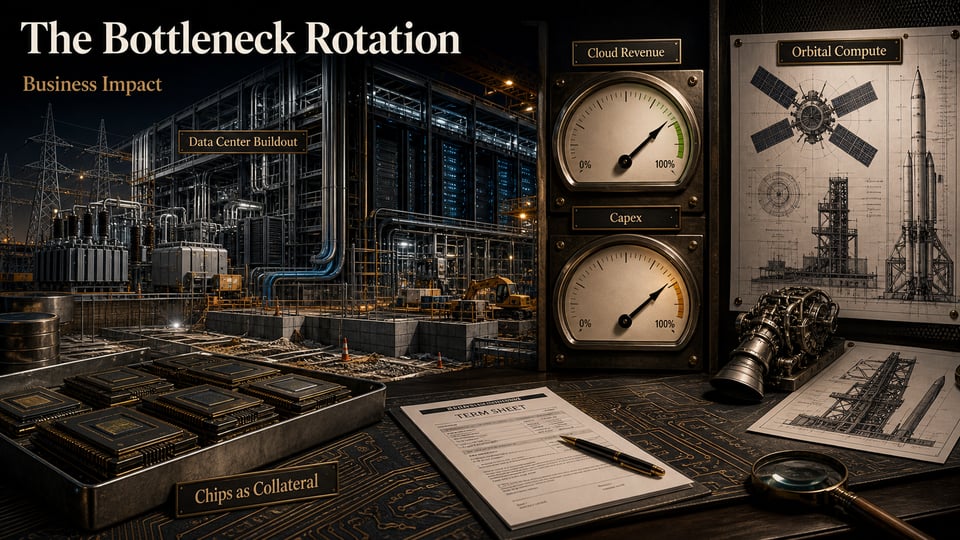
The cycle's biggest financial story is a guarantee. On 2026-08-10, NVIDIA announced a financing platform with Apollo, BlackRock, Blackstone, Brookfield, Goldman Sachs, and KKR to mobilize more than $500 billion in third-party capital for data centers and NVIDIA hardware [5][16]. The novel term: NVIDIA promises that if GPUs used as collateral do not hold their value, it will cover up to 25 percent of the difference [5]. Analysts were quick to name the danger, a structure in which NVIDIA's obligations grow precisely as demand weakens [5]. Bloomberg, cited in the coverage, counts roughly $750 billion of circular deals already worked this summer [5]. Jensen Huang's framing is that AI servers are "AI factories," assets like railroads or airlines, with a secondary market for aging GPUs to protect residual value [5]. The credit plumbing already exists beneath it: data-center ABS and CMBS issuance reached roughly $26 billion in 2025, on track to top $60 billion a year by 2028, led by a $27 billion Meta Hyperion structure, with regulators asking whether the lightly supervised financing is systemic risk [17].
Days earlier, Alphabet had shown what the capital markets now do with good news. Q2 2026 revenue beat at $119.8 billion, up 24 percent, Google Cloud grew 82 percent to $24.8 billion, the fastest growth since at least 2020, with cloud operating margin expanding from 20.7 to 35.6 percent [4][18]. Alphabet then raised its full-year capex guidance to $195-205 billion from $180-190 billion, having already spent $44.9 billion in the quarter, roughly double the prior year, against a $514 billion cloud backlog [4]. The stock fell about 5 percent [4][18]. The CFO's diagnosis matters more than the sell-off: the industry remains supply-constrained, with demand outpacing supply [4].
Together these two stories set the cost of capital for everything downstream. If chips are collateral and capex is punished even alongside 82 percent cloud growth, the financing regime, not the model layer, now prices AI services.
SpaceX's First Public Quarter Puts a Number on Orbital AI
The capital story gained its most concrete data point yet. In its first earnings report as a public company on 2026-08-04, SpaceX posted revenue of $7.81 billion, up 92 percent and well past the $6.93 billion consensus, narrowed its net loss to $541 million, and grew adjusted EBITDA 191 percent to $3.5 billion [7][8]. The market looked past all of it: shares fell about 8 percent after hours because quarterly capital spending hit $18.4 billion, nearly double the first quarter, with the AI portion alone at $15.83 billion against $749 million a year earlier [7][8]. Quarterly capex now exceeds quarterly revenue by more than $10 billion [7]. The AI thesis sharpened beneath the noise: the AI segment, xAI, Grok, and the $60 billion Cursor acquisition, grew revenue roughly 250 percent while losing $1.26 billion operationally, Starlink crossed 12 million subscribers with revenue per user down 22 percent, and management guided to a $100 billion December run-rate and orbital AI compute from as early as 2028 [7][8]. With $100 billion in cash, SpaceX has the runway to test it [7].
Integrators Start Publishing Production Numbers
The demand side produced its own evidence. Cognizant, now one of a small number of Global Premier Partners in the Claude Partner Network, published per-deployment metrics with the announcement: a life-sciences contract-intelligence system that cut contract review time by up to 40 percent while lifting extraction accuracy above 88 percent, and an insurance risk-navigation tool that turned hours of underwriting research into about a minute, saving roughly eight hours per underwriter per week [19]. Claude is being embedded across Cognizant's Flowsource and Neuro platforms, with Claude Code integrated into Flowsource's Spec-Driven Development module, and the company holds the most Claude certifications globally [19]. The absorption gap that Cognizant's CEO calls "the defining problem of this moment" is being closed by certified-workforce scale, and, finally, measured per deployment rather than per pilot [19].
Global Context

The Open-Weights Debate Reframes Around Inputs and Testing
Washington's open-weights fight found its shape. Reports suggest some US officials are considering banning the use of Chinese open-weights models by US companies, prompting many technology companies to sign an open letter in support of open weights [20]. Anthropic's CEO responded with a position post that states plainly that Anthropic has never advocated a ban, that open-weights models without dangerous capabilities are a public good, and that protectionist bans would not address the serious national-security concerns [20]. The counter-proposal has three prongs: keep powerful chips and chipmaking equipment away from China and crack down on smuggling; crack down on industrial-scale distillation, which can bring the Chinese frontier within a few months of the US frontier; and require mandatory safety testing of all sufficiently capable models, open and closed [20].
The direction of travel is notable. Amodei observes that the administration has already moved toward testing-based safety, with industry proposals applying tests regardless of a model's origin or openness [20]. That posture is anchored in Executive Order 14409 of 2026-06-02, which sets US policy to promote AI innovation and security collaboratively with the private sector, harden government and private systems, and protect American IP from adversaries [21]. For practitioners, the stakes are concrete: a ban would fragment the multi-lab open portfolio assembled since June, while a testing regime would create a very different compliance surface, one that the GPT-5.6 system card already resembles [2][20].
The Grid Becomes a Regulated AI Bottleneck
The most literal deadline of this cycle belongs to the Federal Energy Regulatory Commission. On 2026-06-18, FERC issued six tailored orders under Section 206 of the Federal Power Act to PJM, MISO, SPP, CAISO, ISO-NE, and NYISO, directing each to justify its large-load pricing within 60 days or reform it, and to file a reliability report within 30 days on how it will secure generation capacity for large loads [22][23]. The action fulfills a 2025 request from Energy Secretary Chris Wright [23]. The 60-day window closes on or about 2026-08-17, the day this issue publishes [23].
The expected effects are shorter interconnection queue backlogs and new retail large-load rate categories in more states, with recommended protections against cost shifting to residential ratepayers [23]. The connection to the rest of this issue is direct: the $500 billion financing wave converts to data centers only if interconnection succeeds, and queue reform, not chip supply, now sets the pace of the US buildout [5][23].
For operators, the compliance calendar is legible. The 30-day reliability reports forced each grid operator to state publicly how much generation capacity it can guarantee for large loads [22][23], and the 60-day pricing decisions determine who pays for upgrades: large-load customers through new rate categories, or all ratepayers through socialized costs [23]. FERC chose region-specific orders to make the action durable against state challenge, so rules will differ by region even as deadlines are national [23]. Siting decisions now need a regulatory workstream of their own.
Release Breakdowns
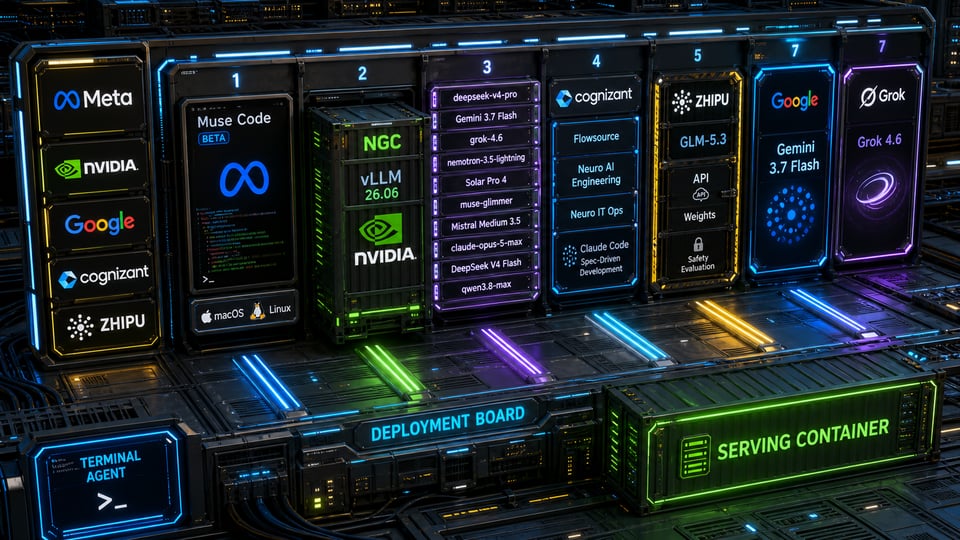
The Two-Week Board
What a practitioner can deploy today:
Muse Code (beta), Meta's terminal coding agent on macOS and Linux, powered by Muse Spark 1.2, also available through the Meta Model API with expanded global access [13].
NVIDIA's vLLM 26.06 container on NGC, supporting Nemotron Super V3, Nemotron 3 Nano Omni, and DeepSeek V4 on CUDA 13.3 [12].
Newly ranked in Arena leaderboards this window: deepseek-v4-pro, Gemini 3.7 Flash, grok-4.6, nemotron-3.5-lightning, Solar Pro 4, muse-glimmer, Mistral Medium 3.5, claude-opus-5-max, DeepSeek V4 Flash, and qwen3.8-max [14].
Cognizant's Claude integration path across Flowsource, Neuro AI Engineering, and Neuro IT Ops, including Claude Code in the Spec-Driven Development module [19].
GLM-5.3, live today through the GLM Coding Plan and ZCode, with API access and weights staged behind safety evaluation; its CyberGym 84.5 percent edges past Mythos 5 and GPT-5.6 Sol [6][10].
Gemini 3.7 Flash, Google's most intelligent workhorse model for coding and agents, three weeks after 3.6 Flash, at an introductory price of half of 3.6 Flash per million tokens; DeepSWE v1.1 65.3 versus 49.0 [24].
Grok 4.6, built for long-running agents, with a 500K context window and pricing from $2 and $6 per million tokens for input and output; it matches GPT-5.6 Sol at 61 on the Artificial Analysis Intelligence Index [25].
Closing Takeaway
The rotation is the story. Cheap near-frontier intelligence and wafer-scale speed arrived the same fortnight that capital structure, grid interconnection, and testing-based policy became the binding constraints. The practitioners who win the next cycle will treat model choice as a line item, inference latency as a product feature, and permits, financing terms, and compliance regimes as the actual frontier. The teams that lose it will still be benchmark-shopping in a market that has moved on to pricing delivery, in dollars, seconds, megawatts, and basis points.
Liked this issue? Forward it to a colleague who needs to stay ahead.
Subscribe to The MediaDataFusion Signal
References
Anthropic. "Introducing Claude Opus 5." https://www.anthropic.com/news/claude-opus-5 . Accessed 2026-08-15
OpenAI Deployment Safety Hub. "GPT-5.6 System Card." https://deploymentsafety.openai.com/gpt-5-6 . Accessed 2026-08-15
Cerebras. "Accelerating GPT-5.6 Sol Ultrafast with OpenAI." https://www.cerebras.ai/blog/accelerating-gpt-5-6-sol-ultrafast-with-openai . Accessed 2026-08-15
metir. "Alphabet Q2 2026 Earnings: Cloud Surges, Capex Hits $205B." https://www.metirai.com/blog/alphabet-q2-2026-earnings-google-cloud-ai-capex . Accessed 2026-08-15
TechCrunch. "Nvidia's new $500B plan is risky but brilliant, especially for aging GPUs." https://techcrunch.com/2026/08/13/nvidias-new-500b-plan-is-risky-but-brilliant-especially-for-aging-gpus/ . Accessed 2026-08-15
MarkTechPost. "Z.ai Ships GLM-5.3 Without Retraining the Base Model: Better at Complex Coding and Long-Horizon Tasks." https://www.marktechpost.com/2026/08/14/z-ai-ships-glm-5-3-without-retraining-the-base-model-better-at-complex-coding-and-long-horizon-tasks/ . Accessed 2026-08-15
The Wall Street Times. "SpaceX Posts First Earnings as a Public Company With 92% Revenue Growth, but $18.4 Billion in Capital Spending Rattles Investors." https://wallstreettimes.com/spacex-q2-2026-first-earnings-revenue-capex-lockup/ . Accessed 2026-08-15
Reuters (via Rappler). "SpaceX revenue jumps in debut results as satellite, AI businesses surge." https://www.rappler.com/technology/spacex-revenue-earnings-august-2026/ . Accessed 2026-08-15
TechCrunch. "Anthropic launches Opus 5." https://techcrunch.com/2026/07/24/anthropic-launches-opus-5/ . Accessed 2026-08-15
explainx.ai. "GLM-5.3 Launch: Benchmarks, Pricing & Access (Aug 2026)." https://www.explainx.ai/blog/glm-5-3-launch-cyber-defense-benchmarks-august-2026 . Accessed 2026-08-15
vllm-project. "Releases: vllm-project/vllm (v0.27.0, v0.27.1)." https://github.com/vllm-project/vllm/releases . Accessed 2026-08-15
NVIDIA. "vLLM Release 26.06." https://docs.nvidia.com/deeplearning/frameworks/vllm-release-notes/rel-26-06.html . Accessed 2026-08-15
Meta AI Research. "Introducing Muse Code and Muse Spark 1.2." https://research.meta.ai/blog/introducing-muse-code-and-muse-spark-1-2 . Accessed 2026-08-15
Arena.ai. "Leaderboard Changelog." https://arena.ai/blog/leaderboard-changelog . Accessed 2026-08-15
Epoch AI. "Benchmarks." https://epoch.ai/benchmarks/search . Accessed 2026-08-15
CNBC. "Nvidia, Wall Street asset managers partner on $500B AI push." https://www.cnbc.com/2026/08/10/nvidia-wall-street-asset-managers-500-billion-ai-push.html . Accessed 2026-08-15
Compute Law Blog. "Bonds backed by AI data center revenue (securitization)." https://computelaw.blog/deals/ai-data-center-securitization/ . Accessed 2026-08-15
CNBC. "Hyperscalers face higher capex scrutiny after Alphabet report panned." https://www.cnbc.com/2026/07/28/hyperscalers-face-higher-capex-scrutiny-after-alphabet-report-panned.html . Accessed 2026-08-15
Cognizant. "Cognizant and Anthropic expand partnership to embed Claude in Cognizant's industry platforms." https://news.cognizant.com/2026-07-27-Cognizant-and-Anthropic-expand-partnership-to-embed-Claude-in-Cognizants-industry-platforms,-helping-clients-close-the-gap-between-AI-promise-and-business-outcomes . Accessed 2026-08-15
Anthropic. "Our position on open-weights models." https://www.anthropic.com/news/position-open-weights-models . Accessed 2026-08-15
The White House. "Promoting Advanced Artificial Intelligence Innovation and Security (Executive Order 14409)." https://www.whitehouse.gov/presidential-actions/2026/06/promoting-advanced-artificial-intelligence-innovation-and-security/ . Accessed 2026-08-15
AP News. "Grid operators are ordered to speed power to energy-hungry AI data centers." https://apnews.com/article/power-electricity-ai-plants-data-centers-grid-506e3d206871111f15c3c62fc5368be5 . Accessed 2026-08-15
American Action Forum. "FERC Data Center Orders Accelerate Grid Connection." https://www.americanactionforum.org/insight/ferc-data-center-orders-accelerate-grid-connection/ . Accessed 2026-08-15
Google. "Introducing Gemini 3.7 Flash." https://blog.google/innovation-and-ai/models-and-research/gemini-models/introducing-gemini-3-7-flash/ . Accessed 2026-08-15
xAI. "Introducing Grok 4.6." https://x.ai/news/grok-4-6 . Accessed 2026-08-15