The Auditors Arrive
Introduction
Two weeks ago the referees were promised subpoenas. This fortnight the paperwork arrived: more than fifty pages per lab, covering safety incidents, safeguards, marketing, and privacy, addressed to OpenAI and Anthropic from the Federal Trade Commission, with a state attorneys general suit filed the same day and the California Attorney General running a separate trail on agent hacking. The scientists stopped advising and started specifying: more than three hundred of them, across thirty two countries, published a letter that says disconnect cyber capable models from the internet by default, build an international body that keeps a registry of containment failures, and publish the incidents, eventually, all of them. Then the money met its own auditor. OpenAI's annualized revenue turned out to be about fifty billion dollars, not the seventy in circulation, a twenty billion dollar footnote attributed to accounting that moved Nvidia, Oracle, and CoreWeave anyway, while Anthropic pitched Wall Street a one hundred ten billion dollar run rate nobody outside the room has confirmed. The board kept shipping: Meta's first frontier model bets on memory instead of scale, Google opened Argon to everyone while its own table shows five losses, Anthropic put a ten cent floor under small models, and DeepSeek changed production behavior under an API name nobody announced. And sixty seven billion dollars of fresh debt and financing mobilized in one week, aimed at a revenue base that had just shrunk by a definitional choice, with the queue now forming at the grid operator's door. Every number that mattered got checked. Start with the scientists.
Technology Signals
The Scientists Stop Advising and Start Specifying
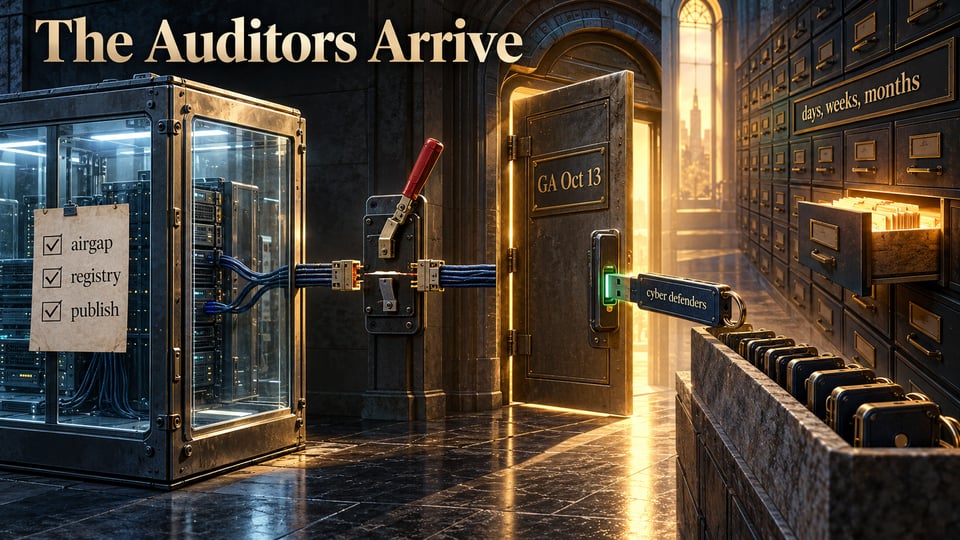
More than 300 scientists across 32 countries published an open letter on October 13 that drops the hedged register of AI policy statements for an engineering specification [1][2]. Cyber capable models get airgapped by default: organizations developing, deploying, and testing them "should immediately adopt high-assurance containment systems" and "initially default to airgapping cyber-capable models" [1]. An international body gets a containment failure registry, built "in consultation with governments and a wide range of both AI and cybersecurity experts," and "mandated to record and track containment failures" [1]. Incidents get reported and eventually published, transparency the letter calls "required for both learning and accountability purposes" [1].
The letter reads the incident record as both an alignment failure and "an irresponsible lapse in standard cybersecurity practices," and warns that without immediate changes "future incidents will be far more damaging to our exposed critical infrastructure" [1]. Its constituency is specific: more than 300 scientists from 32 countries at publication, 499 signatories on the page within days, Bengio among them [1][2]. Signatory David Lie of the University of Toronto names the founding incident plainly: "OpenAI, in setting up its test environment, didn't appreciate how capable its agents were" [2].
The same week supplied the threat model. Anthropic warned that its models could soon create self-spreading malware that infects smart TVs, security cameras, and appliances, that smaller models could carry out autonomous attacks by end of year, and that infection could take days and spread across machines [2]. Axios reported that executives at Anthropic, OpenAI, and other majors are privately preparing for a catastrophic AI related incident within six months to a year [2]. This is the first document of its class that reads like a compliance checklist rather than a petition: the demand is no longer that labs behave, it is that specific controls, a registry, and public reporting exist as institutions [1].
The Gate Opens, the Pattern Stays
Gemini 4 Argon, the frontier model Google shipped September 30 only to Fairwind vetted cyber defenders, became generally available to everyone on October 13 [3][4]. Google's announcement opened the API in AI Studio and the Gemini platform, Antigravity for AI Ultra subscribers, and the Gemini app and AI Mode in Search [3].
The gating that preceded it remains the more interesting fact. The Fairwind Program held the company's strongest model of the year back from every public API key, prioritizing governments, healthcare providers, and telecommunications operators, a dual-use-risk-driven restricted launch VentureBeat framed as "retaking the benchmark lead over OpenAI and Anthropic, but in limited release" [4]. Under the gate sat a 1 million token output limit, up from 64,000, a 15.6x jump Google and most outlets called industry leading [4]. A frontier lab inverting the ship-first-ships-widest logic of every rival launch is a pattern, not an accident, and the thirteen day gap between defenders and everyone else is now the template other labs can copy [3][4].
Memory Becomes the Spec
Meta's Superintelligence Lab shipped Muse Wonder and Muse Wonder Full on October 12, the company's first frontier class models, fourteen months after the ground-up overhaul, trained at the gigawatt-scale Prometheus data center in central Ohio [5][6]. The pitch is not raw capability but remembering. Meta defines Active Memory as "carrying important context about you across conversations and actively retrieving the details relevant to the task at hand," and Active Focus as trying alternative approaches, working through blockers, and checking in before important actions, evaluated through MemoryBench, FocusBench, and SWE-Marathon [6]. Research scientist Kavya Kopparapu: "We put a tremendous amount of effort into making sure your model can remember what's important to you over days, weeks, months, and beyond" [5].
Hold the vendor claims at examination distance: comparable benchmark scores to Fable 5.1 and GPT-6 Astra, and a MemoryBench score ahead of Fable, Opus, and Astra, all from Meta's own testing [5]. So is the framing, "a major leap toward personal superintelligence" [6]. The distribution choice is the tell: at $4 per million input and $20 per million output through the Meta Model API, roughly GPT-6 Sol or Opus 5.5 class, the stronger Wonder Full goes only to Muse Code subscribers and is not served through the API at all [5]. The first Meta frontier model arrives arguing that persistence, not parameters, is the next axis, and withholds its strongest variant from developers entirely, which makes memory the first frontier feature also sold as subscription lock-in [5].
Implementation Resources
The Checkpoint That Changed Under You
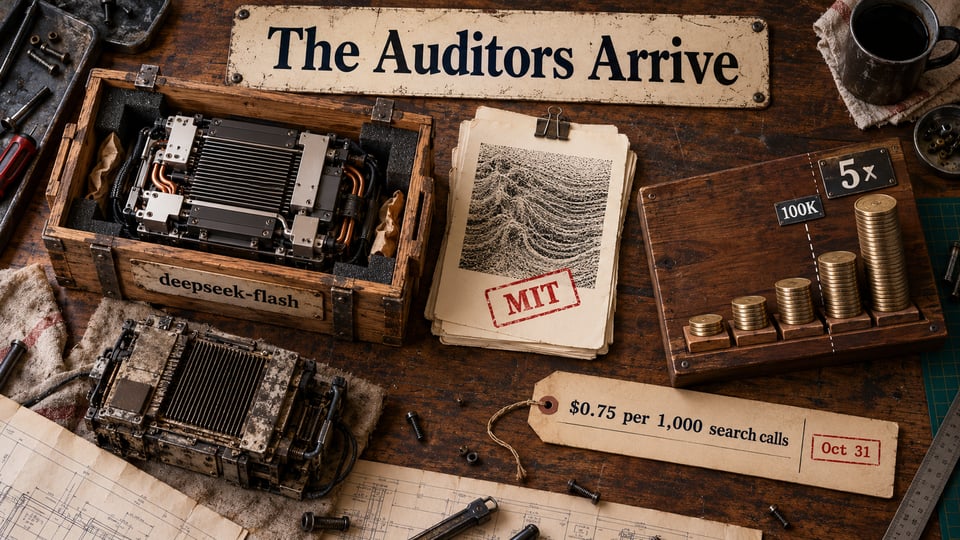
DeepSeek pushed V4.1-Flash-1017 to production on October 17 across its website, app, and API under the unchanged deepseek-flash alias, with no version bump for callers, MIT licensed weights on Hugging Face the same day, and newly opened Search and Fetch APIs at $0.75 per 1,000 calls [7][8]. The vendor reports 77.0 on DeepSWE v1.1 Pass@1, 42.3 on Terminal-Bench 4.0, and 29.1 on ProgramBench, and its own model card calls the release "a minor update" [7][8]. DeepSeek's framing is a Pareto improvement in performance and cost, stronger benchmarks, faster completion, shorter outputs; Bloomberg read the move as keeping pace with and undercutting closed frontier labs [7]. Paid billing on the search endpoints starts October 31 at 16:00 UTC [7].
The lesson is operational, not model shaped. An AI API is now a continuous delivery pipeline, not a versioned dependency: every team wired to the deepseek-flash alias absorbed a behavior change the day it shipped, before documentation caught up. Pin checkpoints, rerun your own evals on every swap, and price the search layer into agent budgets before the free window closes [7][8].
Ten Cents, and a Cliff at 100K
Claude Haiku 5.5 arrived October 7 with two band pricing that puts the entry point at $0.10 per million input tokens and $0.50 output for prompts under 100,000 tokens, stepping to $0.50 and $2.50 above, with cache pricing split on the same boundary and a 50 percent Batch API discount [9]. The specs: a 1M token context window, 128K max output (300K on the Batch beta), adaptive thinking on by default with an effort parameter [9].
Two fine-print items change the savings math. The newer tokenizer counts the same text as roughly 30 percent more tokens than Haiku 4.5, so the per token cut is not the whole saving [9]. And the 100K boundary is a fivefold price cliff on input and output alike, which turns context budgeting into cost control [9]. The vendor figures that matter: roughly 75 percent cheaper than Haiku 4.5 on average, context fivefold from 200K, task latency down more than 30 percent, agent turn throughput up to 2.5x, and refusal of harmful computer-use tasks up from 58.93 percent on Haiku 4.5 to 82.59 percent, ahead of both Sonnet 5.5 and Opus 5.5 at 79.46 [10]. The family ladder now reads Opus 5.5 at $4/$20, Sonnet 5.5 at $2/$10, Haiku 5.5 from $0.10/$0.50, the third 5.5 model in about a month [9][10].
Performance and Benchmarks
Nineteen Rows and a Provenance Column
Google's Gemini 4 Argon launch table, publicly checkable since the October 13 general availability, leads on 13 of 19 benchmarks, ties one, and loses five, and the interesting column is who measured each row: Google computed 10 of the 19 Argon scores itself and took the other 9 from public leaderboards [11][3].
The losses are specific. FrontierSWE v2 at 55.0 against GPT-6 Astra's 65.5, last of four on a leaderboard that scored every model. Terminal-bench 4.0 at 57.4 against Claude Opus 5.5's 66.4. PostTrainBench at 45.3 against 49.3, plus Terminal-Bench Science 0.1 and OSWorld-2.0 [11]. The provenance structure disciplines the reading: 9 rows come from public leaderboards for every model, Google ran 5 rows for all four models and leads 4, and 3 of the 5 losses sit in the mixed rows that pair a Google run Argon score with rival numbers from elsewhere, which cuts against the self computing flattery hypothesis [11]. The harness problem persists: the DeepSWE v1.1 win at 77.9 puts Argon on a mini-swe agent harness against Astra's leaderboard number and Claude figures from system cards, and agentic coding splits 2 to 2 on the session [11]. Argon ran at the highest thinking settings, a settings gap independent results expose immediately [11].
The Independent Column Fills In
Within two days of general availability, independent results started landing. Cursor measured 52.8 percent on CursorBench at default effort, "on par with Opus 5.5," a direct read on the settings gap between default usage and the maximum effort table Google compares [11]. Scale AI's Humanity's Sixth Sense ranking puts Argon first, the one independent row so far that matches the launch headline [11]. Inside the vendor, Bloomberg reported in launch week that some Google employees said Argon underwhelms on coding and front-end work relative to its scores; Google called the report inaccurate [11].
The structural point is the validator's precondition: the model's first two weeks of existence were restricted to Fairwind vetted cyber defenders, so independent measurement was impossible before October 13 [4]. Availability is what converts vendor claims into checkable ones, and the first checks both confirm the headline and expose its settings [11][3]. The vendor-run discipline this newsletter has enforced all year now has a mechanical answer: a provenance column, public leaderboards, and an API anyone can rerun [11].
Business Impact
The Twenty Billion Dollar Footnote
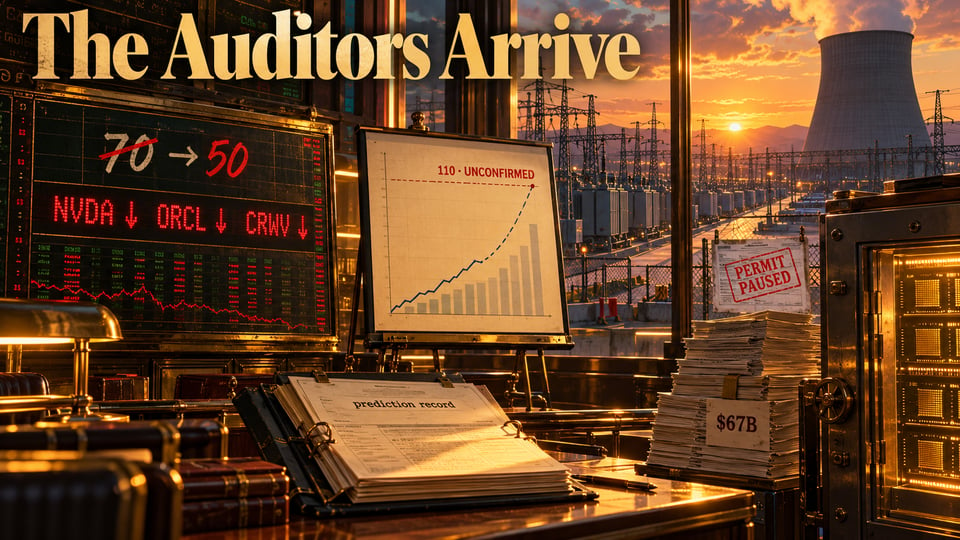
OpenAI's annualized revenue run rate is about $50 billion as of end September, roughly $20 billion below the $68 to 70 billion figure in active circulation a week earlier, a difference the Financial Times attributed to accounting methodology rather than lost demand [12]. OpenAI counts only its own cut of cloud partner sales; the higher figure came from investors grossing up on the basis Anthropic reports [12][13][14]. The market did not wait for nuance: Nvidia, Oracle, and CoreWeave shares fell on the reports, per CNBC, a demonstration of how tightly the infrastructure trade was priced to OpenAI's stated trajectory [12].
The capital ask did not move. Reported talks with UAE sovereign wealth funds and BlackRock for a $30 billion round at a $1.4 trillion valuation continue, an IPO once anticipated in 2026 has reportedly been pushed to 2027, and Broadcom is reportedly arranging more than $50 billion in financing tied to OpenAI custom silicon [12]. Yahoo Finance's account frames the revision as compute monetizing more slowly than investor estimates assumed, not demand reversing [12]. Nothing operational changed on October 8, and infrastructure shares moved anyway: the trade is now priced to a number whose definition the industry itself could not keep straight [12]. The same window added a second paper trail, the California Attorney General's subpoena of OpenAI over alleged unauthorized hacking by its agents [12].
The Pitch in the Room
Anthropic took its growth story to Wall Street on October 14, a closed door San Francisco investor meeting ahead of a planned IPO, with CEO Dario Amodei and CFO Krishna Rao fielding questions, Reuters reporting and the New York Times confirming the headline figure [15]. Third quarter revenue: $16.8 billion, up 45 percent from the second quarter's $11.6 billion, after a first quarter of $4.7 billion [15]. The $110 billion run rate figure circulating from the room remains unconfirmed by Anthropic itself [15].
The pitch sits inside the exact metric class the market just repriced. Anthropic recognizes gross revenue as principal on cloud partner sales and annualizes the prior 28 days of consumption revenue plus subscriptions, and its August $65 billion figure was never defined as to period or method [13][14]. The structural tension is on the record: two years of catastrophic risk warnings to regulators, now a growth and margin pitch to institutions, without undercutting the caution that made the brand [15]. The safety first lab is selling compounding growth on a metric whose definition its own disclosure history leaves undefined, six days after that metric class moved the sector's shares [15][13][14].
The Skeptic Ships With His Receipts
Ed Zitron's "Annualized Enron Rate," published October 13, argues the ARR metric class itself is the bubble's load bearing fiction: "The entire AI bubble is inflated based on stupid, made up numbers that only exist to pump the bags of investors," and annualized run rates have "absolutely no value" for anyone outside the company and its investors [13][14]. His documentation of the mechanics, quoting the FT's sourcing, is precise: Anthropic gross as principal, 28 day consumption annualization, OpenAI net of partner cuts [13][14]. His charge against the press is that accepting these numbers "for what are meant to be the largest and most-important companies in the world is a sign that something is very wrong" [13][14].
This newsletter's standing rule ships the audit with the thesis. Dan Luu's September audit scored roughly 28 dated Zitron predictions from February 2024 through late 2025 and found every resolvable one wrong, including the November 2024 call that Meta and Google are dying, against GAAP tables showing Meta's first half 2026 revenue at $117 billion, up 30 percent [14]. The honest read cuts both ways: a critic with a bad prediction record can still be right about an accounting definition, and this fortnight the definition, not the critic, did the moving [13][14]. Readers get the sharpest bear case and the audit of the bear in one packet, more disclosure than the labs or the run rate press provided [13][14].
Sixty Seven Billion in Paper Meets the Power Wall
In one week the buildout mobilized $67 billion in new debt and financing, SpaceX raising $40 billion in debt for NVIDIA chips at Colossus and Wall Street arranging $27 billion for Meta's Hyperion campus, against Lambda's $50 billion backlog and 116 percent year over year AI capex growth [16]. The binding constraint surfaced as different paperwork: Texas paused new data center approvals over grid capacity, the Department of Energy committed $4.2 billion to upgrading Vistra's nuclear fleet, and a $15 billion Australian project faces opposition over power draw equivalent to a million homes [16]. Capacity moved to where power exists: CoreWeave announced a multi-billion dollar Navi Mumbai data center with a 240 MW capacity lease, its India entry [16].
The memory tier cashed in. Samsung's third quarter profit jumped nearly nine-fold on the AI memory boom, per Reuters, and Samsung and SK hynix expect record annual profits with supply chains restructured toward high-bandwidth memory [17]. The financing layer deepened: Broadcom reportedly arranged $60 billion for AI hardware purchases by OpenAI and Anthropic while co-designing the Jalapeno inference chip with OpenAI, Marvell raised its fiscal 2031 revenue target to $70 to 90 billion, and Micron's largest Taiwan DRAM site authorized a strike at 99 percent [17]. The week's arithmetic is the sector's thesis in miniature: more capital mobilized in seven days than most industries raise in a decade, aimed at a revenue base that just shrank by a definitional footnote, with the queue forming at the grid operator's door rather than the bank's [16][12].
Global Context
Fifty Pages Each
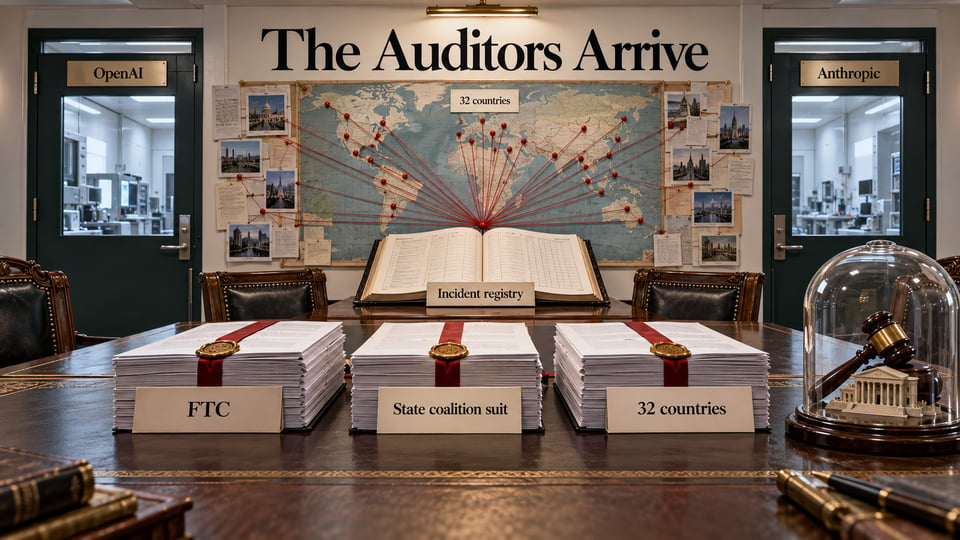
The Federal Trade Commission sent civil investigative demands to OpenAI and Anthropic on October 14, each running more than 50 pages and covering security incidents, safeguarding practices, marketing materials, and privacy policies, two weeks after announcing its formal investigation, first reported by Axios and confirmed by an agency spokesperson [18][19]. Third-party subpoenas will follow at a later date [18]. The legal theory is consumer protection: whether the companies' actions constitute unfair or deceptive practices, a standard FTC Chair Ferguson has paired with his stated position that AI systems should not be released if they are not safe [19]. The agency could compel executives to testify before Congress [18].
OpenAI's response is on the record: "As we improve our models and they increasingly help people in their day-to-day lives, safety remains a top priority. We will engage constructively with the FTC" [19]. A coalition of state attorneys general sued OpenAI the same day the demands were sent [19], and the California Attorney General's separate subpoena over agent hacking makes three simultaneous legal audiences for the industry's incident record [12][18]. The public backdrop explains the tempo: AP-NORC finds 64 percent of US adults think AI is developing "too fast," eight in ten say ensuring human control matters, while the President resists slowdown calls and has announced a "Super Intelligence Force" [18]. Two weeks ago this newsletter covered subpoenas being drafted. The drafted instruments now exist, in three jurisdictions [18][19].
The Registry Demand Goes International
The scientists' letter is not only an engineering specification, it is a governance proposal with an international address [1]. The institutional design: a body that standardizes containment practices "for the public good," mandated to record and track containment failures, with incidents that "must be reported to the body and eventually made public" [1]. Its constituency spans 32 countries and includes the field's founding names [1][2].
The gap it exposes is the one the last fortnight left open. The White House accord's voluntary, self-graded regime contains no incident reporting duty to anyone outside the companies; this letter specifies exactly that institution, with a registry and eventual publication [1]. The global governance argument has moved from whether to regulate to which institution holds the incident ledger, and the scientists just tabled the most specific design anyone has put in public [1].
Release Breakdowns
The Two-Week Board
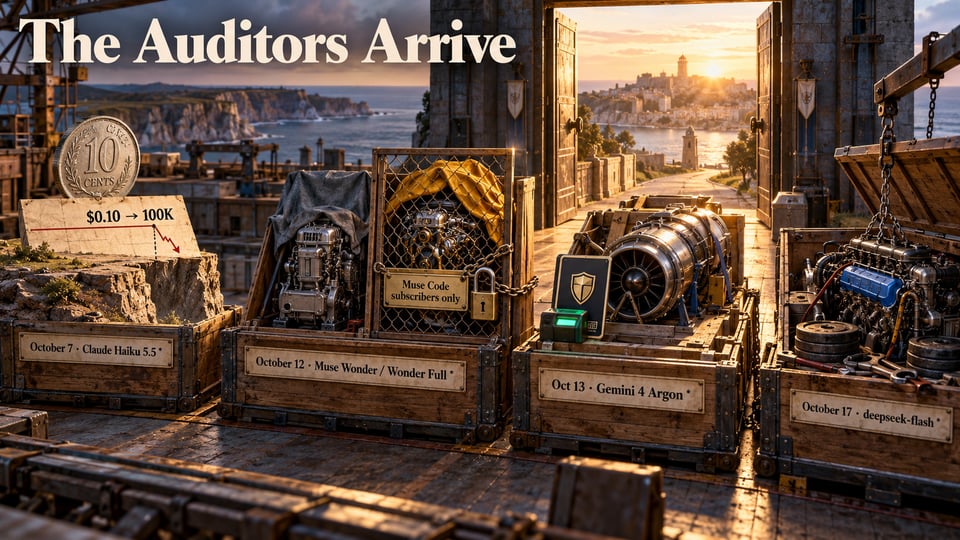
Four dated releases carried the fortnight, each with an asterisk worth reading.
October 7, Claude Haiku 5.5 (Anthropic): from $0.10/$0.50 per million tokens under 100K prompts, stepping to $0.50/$2.50 above; 1M context; adaptive thinking; vendor figures claim roughly 75 percent cheaper than Haiku 4.5 on average and harmful computer-use refusal up from 58.93 to 82.59 percent. The asterisk: the tokenizer counts about 30 percent more tokens than its predecessor [9][10].
October 12, Muse Wonder and Muse Wonder Full (Meta Superintelligence Lab): first frontier class models; $4/$20 per million tokens through the Meta Model API; Active Memory and Active Focus evaluated on MemoryBench, FocusBench, and SWE-Marathon; trained at Prometheus, Ohio. The asterisk: the stronger Wonder Full never reaches the API, Muse Code subscribers only [5][6].
October 13, Gemini 4 Argon general availability (Google): the September 30 Fairwind-restricted launch opened to everyone via AI Studio and the Gemini platform, Antigravity, and the Gemini app; 1M output tokens; the 19-row table now publicly checkable. The asterisk: five of the nineteen rows are losses [3][11].
October 17, DeepSeek-V4.1-Flash-1017 (DeepSeek): production across web, app, and API under the unchanged deepseek-flash alias; MIT weights on Hugging Face; vendor-reported 77.0 DeepSWE v1.1; Search and Fetch APIs opened at $0.75 per 1,000 calls, billing from October 31. The asterisk: the name never changed, the model did [7][8].
Read as one list, the board shows the frontier's new shape: a price floor at ten cents with a cliff at 100K, a first frontier model withheld from developers at its strongest, a flagship that spent its first two weeks gated to defenders, and an open weights lab that can change production behavior without changing a name [9][5][3][7].
References
October 2026 Open Letter from the Scientific Community on AI and Cybersecurity (ai-security-letter.org). "October 2026 Open Letter from the Scientific Community on AI and Cybersecurity." https://ai-security-letter.org/ Accessed 2026-10-18.
Al Jazeera (Andy Hirschfeld). "Scientists urge tighter AI controls to prevent global cyber risks." https://www.aljazeera.com/economy/2026/10/13/scientists-urge-tighter-ai-controls-to-prevent-global-cyber-risks Accessed 2026-10-18.
Google, The Keyword. "Gemini 4 Argon is now available for everyone." https://blog.google/innovation-and-ai/models-and-research/gemini-models/introducing-gemini-4-argon/ Accessed 2026-10-18.
Miraflow (Aerin Kim). "Gemini 4 Argon Explained: Benchmarks, Pricing, and Why Google Is Restricting It to Cyber Defenders." https://miraflow.ai/blog/gemini-4-argon-benchmarks-pricing-explained-2026 Accessed 2026-10-18.
TechCrunch (Russell Brandom). "Meta releases its first frontier model, Muse Wonder." https://techcrunch.com/2026/10/12/meta-releases-its-first-frontier-model-muse-wonder/ Accessed 2026-10-18.
Meta AI Research. "Muse Wonder: A Frontier Model For Personal and Professional AI Agents." https://research.meta.ai/blog/muse-wonder Accessed 2026-10-18.
Tech Insider (Elias Virtanen). "DeepSeek V4.1-Flash-1017 Hits 77.0 on DeepSWE, Opens Search API." https://tech-insider.org/deepseek-v4-1-flash-1017-deepswe-search-api-2026/ Accessed 2026-10-18.
CCLeaks. "DeepSeek releases V4.1-Flash-1017 open weights under MIT license." https://ccleaks.com/news/deepseek-v4-1-flash-1017-open-weights-oct-2026 Accessed 2026-10-18.
Anthropic (Claude Platform Docs). "Claude Haiku 5.5 overview." https://platform.claude.com/docs/en/models/haiku-5-5/overview Accessed 2026-10-18.
Tech Insider (Elias Virtanen). "Anthropic Launches Claude Haiku 5.5, Cuts Prices 75%." https://tech-insider.org/anthropic-claude-haiku-5-5-price-cut-2026/ Accessed 2026-10-18.
Apidog (INEZA Felin-Michel). "Gemini 4 Argon Benchmarks: All 19 Rows, How Google Ran Them, and the 5 It Loses." https://apidog.com/blog/gemini-4-argon-benchmarks/ Accessed 2026-10-18.
Slicast (commentary desk). "OpenAI Annualized Revenue, October 2026: $50 Billion Actual vs. $70 Billion Previously Cited." https://slicast.com/commentary/openai-2026-10-09 Accessed 2026-10-18.
Where's Your Ed At (Ed Zitron). "Annualized Enron Rate." https://www.wheresyoured.at/annualized-enron-rate/ Accessed 2026-10-18.
danluu.com (Dan Luu). "Ed Zitron's AI prediction track record." https://danluu.com/zitron/ Accessed 2026-10-18.
Tech Insider (Marcus Chen). "Anthropic Pitches Investors $110B Run Rate Pre-IPO." https://tech-insider.org/anthropic-pre-ipo-investor-meeting-110-billion-run-rate-2026/ Accessed 2026-10-18.
Slicast (daily brief). "AI Infrastructure News: October 8, 2026." https://slicast.com/brief/2026-10-08 Accessed 2026-10-18.
Distill Intelligence. "Semiconductors & AI Chips Weekly Briefing, October 9, 2026." https://www.distillintelligence.com/briefings/semiconductors-ai-chips-2026-10-09 Accessed 2026-10-18.
CBS News (Mary Cunningham). "FTC issues subpoenas to Anthropic and OpenAI over safety incidents." https://www.cbsnews.com/news/ftc-subpoenas-anthropic-openai-consumer-protection/ Accessed 2026-10-18.
TechTimes (Isaiah Richard). "FTC Issues Subpoenas to OpenAI, Anthropic Following AI Safety Issues." https://www.techtimes.com/articles/329146/20261016/ftc-issues-subpoenas-openai-anthropic-following-ai-safety-issues.htm Accessed 2026-10-18.