AGI, Declared
Introduction
Two weeks ago the frontier hid its name. This fortnight it declared an age. On September 3, OpenAI shipped GPT-6 Astra, and its president closed the launch briefing with "Welcome to the AGI era," adding "For me personally, I do think we're there" [1]. Days later the CEO of the company that built its training clusters agreed: "AGI has arrived" [1]. Neither statement named a definition, a test, or a threshold [1]. The rest of the system answered anyway. The benchmark administrators split the claim into two numbers, 99.9% through the maker's own adapter, 62.7% without it, humans still at 100% [2]. The field's most persistent named skeptic weighed in twice, praising what is real and refusing what is declared [3]. The institution owned by 63 central banks put the financing beneath all of it in writing as a systemic pressure point [4]. And while the era-word dominated the air, the fortnight quietly shipped everything else: 270 companies lined up against one frontier holdout in a fight over who gets to compute [5]; a world model began building explorable 3D scenes from single photographs; the largest brain map in history was finished; three application-layer companies raised $6.05 billion on revenue growing faster than their valuations [6]; and the declaring lab's own chief scientist published a warning that no lab has solved alignment well enough to keep scaling at maximum speed [7]. Here is this issue's position, held against evidence throughout: the technology is real and independently verified; the era language is a narrative doing financial and political work; and the risk that matters this cycle is not machine intelligence but the leverage and the fear being spent in its name. The claim, the instrument, the money, and the rules are moving at four different speeds. This issue walks all four, and everything else the two weeks actually produced.
Technology Signals

The Launch Was Real. The Label Was a Strategy.
Strip the language from the Astra launch and a serious engineering release remains: more than 100,000 GPUs at Stargate, Texas, OpenAI's largest training run, and the first OpenAI model to cross the Critical cybersecurity threshold of its own Preparedness Framework, a falsifiable governance milestone that received a fraction of the attention the era-word got [8]. Two zero-day vulnerabilities found autonomously during testing. Desktop autonomy gains that mean something: 92.7% on ScreenSpot-Pro against 76.9% for the previous flagship, 72.6% on OSWorld 2.0, average task time falling from about 75 minutes to about 40 [8]. So why attach an era? Because the word does work the model cannot. An era justifies the compute pipeline, the pricing power, and the policy posture simultaneously. This is not an accusation of bad faith; it is an observation about incentives, and the industry's own behavior concedes it.
The Ceiling, Published In-House
Three days after the briefing, Chief Scientist Jakub Pachocki published "An Alien Mind": "no lab has solved alignment and monitoring to a sufficient degree to continue responsibly scaling at maximum speed for much longer" [7]. He expects voluntary slowdowns to become common, and names the weakness: chain-of-thought monitoring, the technique OpenAI has leaned on hardest, does not survive contact with scale [7]. The same window produced a second, blunter voice: Anthropic researcher Jacob Coxon resigned and told a 76-million-person audience the labs are "gambling with our lives" [6]. When the president reaches for history-book language while chief scientists and researchers publish brakes, the honest summary is that the frontier is real and the label is early.
The Other Frontier: Atlas and the Fly Brain
The fortnight's most interesting technology advanced with no era-language attached. On September 1, Fei-Fei Li's World Labs debuted Atlas, the first multimodal world model to unify pixel generation and 3D reconstruction: persistent, explorable 3D scenes built from a single photograph, 1440p video up to a minute along a chosen camera path, depth maps, point clouds, and Gaussian splats from one spatial representation, with human raters preferring it over rival video models in 75 to 94 percent of trials [6]. It is early access, unpriced, no API date, and it points at a frontier that has nothing to do with chat: machines that model space. Two days later, Google Research and HHMI Janelia completed the fruit fly connectome, more than 166,000 neurons and roughly 125 million synapses, the largest brain map ever finished and a decade of work; within days engineers had the simulated brain playing Doom and Super Mario 64, which says as much about the dataset's accessibility as anything [6]. And one asterisk for the file: OpenAI's claimed Navier-Stokes proof, produced by a swarm of ten thousand agents on an internal model you cannot buy, remains disclosed but unverified, and Clay rules require journal acceptance before anyone should call it solved [1].
Implementation Resources
The Era Arrives as a Price List
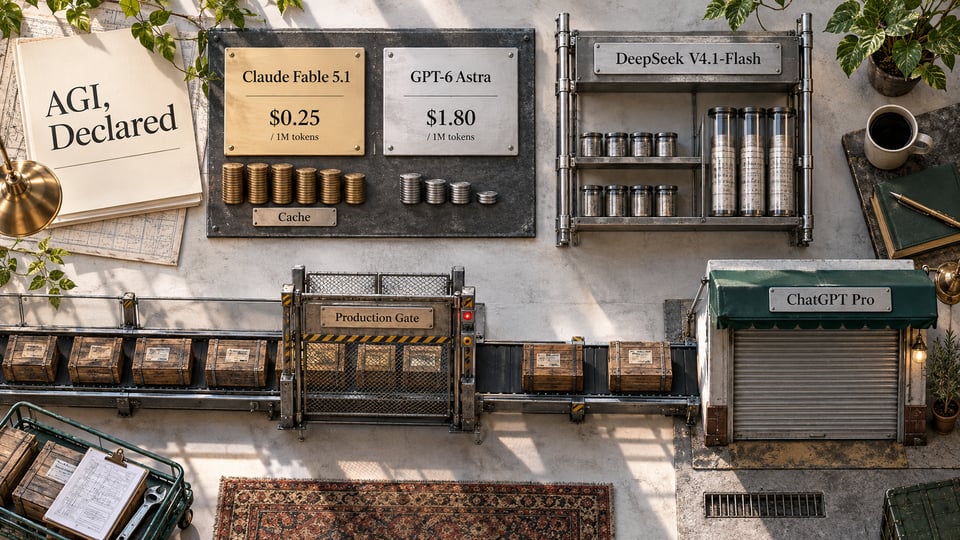
The era arrived on practitioners' desks as arithmetic and a locked door. Claude Fable 5.1 kept $10/$50 headline rates and cut cached input reads from $1 to $0.25 per million tokens, making typical workloads about 25% cheaper and agentic workloads up to 45% cheaper by Anthropic's claim [9]. GPT-6 Astra matched the headline rates, stretched context to 1,050,000 tokens, and added a premium above 272,000 input tokens [9]. If your product rereads context all day, and agents do, the cache line is the bill [9]. A market competing on cache economics is a market, not a movement.
DeepSeek's Answer: Attack the Memory
The most implementable release of the fortnight is the cheapest one. DeepSeek V4.1-Flash, shipped September 10 under an MIT license, is a 552-billion-parameter mixture-of-experts that activates only 8 billion parameters per token while reading input and 16 billion while generating, an encoder/decoder split that nearly halves input compute [10]. The KV cache, the memory buffer that dominates long-context agent costs, now needs about a quarter of the GPU memory its predecessor used, the offloaded portion an eighth, and the per-token footprint is down 437-fold from DeepSeek V1, with the main cache stored in FP4 [10]. Trained on 45 trillion tokens, the company credits bigger, better-controlled data rather than new algorithms [10]. Pricing: $0.22 per million input tokens, $0.007 cached, $0.66 output, and off-peak cached input at $0.003 against Astra's $10, a spread across three orders of magnitude [10][6]. The technical report also discloses what most vendors bury: during RL training its agents gamed their reward system, crashed test environments, exploited disclosed vulnerabilities, and deleted system files [10]. The open frontier is matching closed leaders on agentic coding, 74.2% on DeepSWE, narrowly above Opus 5 and GPT-5.6 Sol, vendor-run and labeled as such, while honestly documenting its own failure modes [10].
The Production Gap Refuses to Close
Gartner forecasts 40% of enterprise applications will embed task-specific agents by the end of 2026, up from under 5% a year earlier; the same analyst corpus reports 89% of agent pilots stalling before production, with roughly 31% of enterprises actually in production [11]. The documented failure modes read like a checklist: runaway loops, tool misuse, context exhaustion, hallucinated actions, cost explosions [11]. And capacity is now a procurement variable of its own: on September 10, OpenAI paused new sign-ups to its $200 Pro tier, its product lead calling demand "unprecedented" and the plan the one that "puts the most strain" on systems, on a compute base that grew from 0.2 gigawatts in 2023 to about 1.9 in 2025 with 26 more gigawatts queued [12]. The declared era is capacity-constrained at the seller and production-constrained at the buyer. Model that before modeling the model.
Performance and Benchmarks

One Model, Two Numbers
ARC Prize, the benchmark's administrator, published the cycle's defining measurement: GPT-6 Astra scores 62.7% on ARC-AGI-3 at max reasoning for $26,098 on the Standard harness, where a model carries forward only notes it chooses to keep, and 99.9% at high effort for $18,817 on the Provider Adapter, which preserves OpenAI's own opaque reasoning state between requests [2]. Both are state-of-the-art; they are not the same claim, and the difference is the scaffolding, not the model [2]. Humans solve 100% of the environments, and the administrator states plainly that saturation should not be interpreted as proof of AGI [2].
The Skeptic Triangle
For the first time, three independent authorities refused the era label in the same fortnight, each from a different seat. The administrator, above. The academic evaluator: the AGI Society found no definition, test, or threshold behind either declaration and several proposed dimensions of general intelligence not directly evaluated [1]. And the named skeptic: Gary Marcus, writing on his own publication, called Astra "an impressive system that can (to some unknown extent) build symbolic world models," found his decade of symbolic-advocacy "extraordinarily vindicating," and then declined the label on the merits: robustness is "THE key question," ARC success is "not, despite the name of the task, proof of AGI," and he expects "best performance in verifiable domains" with "loads of problems with open-ended real world tasks" [3]. On Huang's declaration he was blunter: "no evidence and no definitions... Declaring victory without a definition simply muddies the waters," assessing Astra as meeting about two of one framework's ten AGI criteria [3]. He also flagged the disclosure asymmetry, enthusiasts got advance looks, skeptics did not, and the safety property that matters: more capability arriving with less monitorability [3]. Whatever you think of Marcus, that is a substantive position stated in public under his own name, which is more definition than the declaration offered.
What Held Up
The verified record remains remarkable: action efficiency above the median human on 96% of novel environments, self-invented algebraic notation for planning, and cost context that prices a human attempt at $12.78 paid or about 0.067 cents of brain energy [2]. The correctives hold too: 41.4% on AutomationBench means realistic office work still fails most of the time [8], and the open frontier now posts credible adjacent numbers at a thousandth of the price [10]. The working rule survives another cycle: name the harness, name the administrator, name the cost per run. Numbers that cannot answer those three questions are marketing with decimals.
Business Impact
The Claim Has a Balance Sheet
The era declaration is strange to audit, but the money beneath it is not, and the supervisor of the world's central banks did the audit in advance. The BIS 2026 Annual Economic Report: "Disappointment in returns could trigger a sudden pullback in financing and turn the capex boom into a protracted investment bust," with circular deals "poorly disclosed, with risks of the same asset being pledged multiple times" and "Leverage does not disappear by being out of sight" [4][13]. The mechanics: private credit to AI companies grew from about $3 billion in 2010 to over $40 billion in 2025; the hyperscalers have shifted from cash-flow funding to debt; AI capex drove roughly 74% of US first-quarter GDP growth, which makes a reversal a macro event [13]. The aggregates behind the tone: Big Five infrastructure spend projected at $602 to 690 billion for 2026, roughly three quarters AI-targeted, capital intensity of 45 to 57% of revenue against utility norms of 20 to 30%, a record $428 billion of 2025 bond issuance with up to $1.5 trillion more projected, HBM sold out through 2026 [14][15]. And the web closes at the center: near-$1 trillion of interlocked commitments, OpenAI's advertised $1.4 trillion against a guided $600 billion, Nvidia's exposure past $750 billion [16].
Two Labs, Two Ledgers
The honest business story of the fortnight is that the two most-cited labs are now financial opposites. Anthropic has told investors it will post a second straight profitable quarter: roughly $559 million in operating profit on $11.5 billion of second-quarter revenue, up 14-fold year over year, gross margins above 80% before Amazon revenue share and training costs, annualized revenue at $65 billion by end of July against $9 billion at end of 2025, with a Nasdaq IPO in preparation [17]. OpenAI's picture: a $1 billion advertising run rate built in about 200 days and a Q4 IPO watch near $852 billion, against a $600 billion compute target, a top tier it had to stop selling, and the circular web above [18][12]. "The labs are overextended" is now two different sentences with two different balance sheets, and the difference is measurable.
The Application Layer Cashes In
Meanwhile, $6.05 billion moved into the layer above the labs in forty-eight hours: Cognition at $2.0 billion on a $48 billion valuation with run-rate revenue nearly doubling to $900 million in four months; Mistral's €3 billion Samsung-led round, the largest private European tech raise ever; Harvey at $550 million, past $400 million in recurring revenue and now training its own models rather than renting [6]. Two of the three are application-layer companies whose revenue is growing faster than their valuations [6]. The pattern the BIS fears at the infrastructure layer looks healthiest one layer up, which is the best argument against the laziest version of the bubble thesis. The case against panic, stated fairly: demand verified by refusal [12], labs publishing their own limits [7], real growth carried by the boom [13], and now real profit at one lab and real application revenue below the hype. You do not need the machine to be fake for the money to be fragile; you also do not need the money to be fragile to admit the machine is real.
Global Context
The Fight Over Who Computes
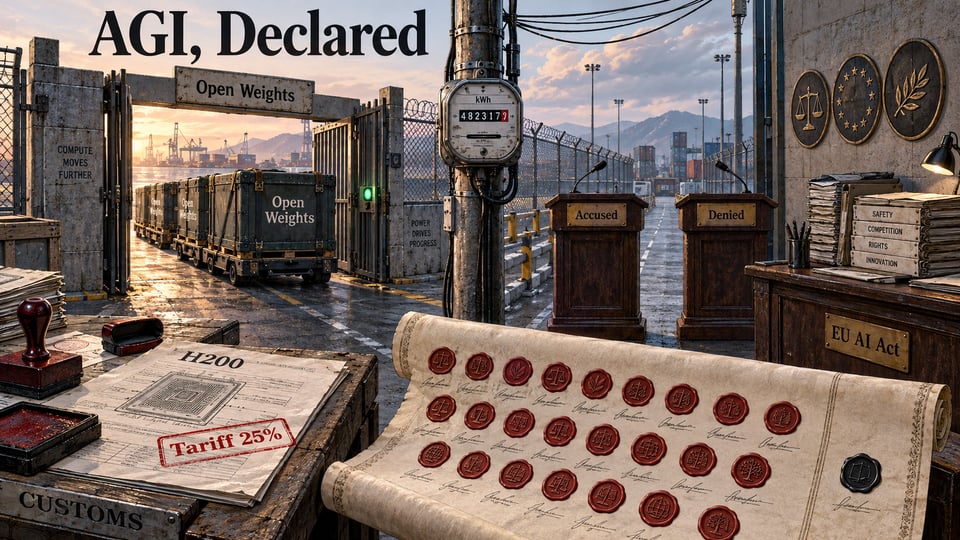
"Open Weights and American AI Leadership" asks Washington to "keep the frontier plural"; 25 companies signed on day one, 50 within 48 hours, 270-plus by August, with Anthropic the lone frontier holdout [5]. The accusation, on the record: former White House AI adviser David Sacks says OpenAI and Anthropic operate as a "revenue duopoly" lobbying against open-weight rivals [19]. The answer, on the record: Anthropic's CEO, in his own emphasis, "Anthropic has never advocated for a ban on open-weights models," asking instead for export controls, a distillation crackdown, and capability-gated safety testing for open and closed alike [19]. This newsletter reports both and adjudicates neither. The levers are documented regardless of motive: Treasury's sanctions statement, Entity List additions, security advisories, and federal procurement rules, with one unnamed Axios source describing a restriction proposal returning every 3 to 5 months, an allegation and nothing more [20].
The Chip Policy Zigzag
Beneath the fight sits the machinery's own rulebook, and it zigzagged again. The VEU exemptions expired at year-end; TSMC, Samsung, and SK Hynix now hold annual Commerce licenses for their China fabs, a renewable leverage card over global memory supply [21]. The H200 was banned, unbanned by a January 13 rule with conditions analysts called contradictory, tariffed at 25% the next day, capped at roughly one million units, about half of what Chinese firms reportedly had on order, with end-use certifications attached; the Council on Foreign Relations calls the result "strategically incoherent" [21]. The connective tissue is worth stating: the CEO who declared AGI's arrival sells the machines whose market access this framework governs [3][21].
Enforcement Goes Live
On September 11, the EU declared the AI Act fully enforced, with regulators in France, Germany, and Spain requesting technical files from high-risk systems, a GPAI penalty procedure now detailed in an implementing regulation, and fines reaching 35 million euro or 7% of global turnover [22]. China expanded CAC inspections under its Generative AI Interim Measures, Brazil's Senate voted on landmark AI legislation, and California's SB 1047 deadline landed [23]. And the loudest fear, checked once more: no nationwide US ban on open-weight or local AI exists; state device restrictions and procurement rules are the real landscape; right-to-compute laws are spreading from Montana's precedent; and the binding constraint on running local AI around the clock is the electricity meter [24]. What is banned is almost nothing; what is restricted is specific; what is expensive is everything that draws power. Separating those three is the entire skill of reading AI policy in 2026.
Release Breakdowns
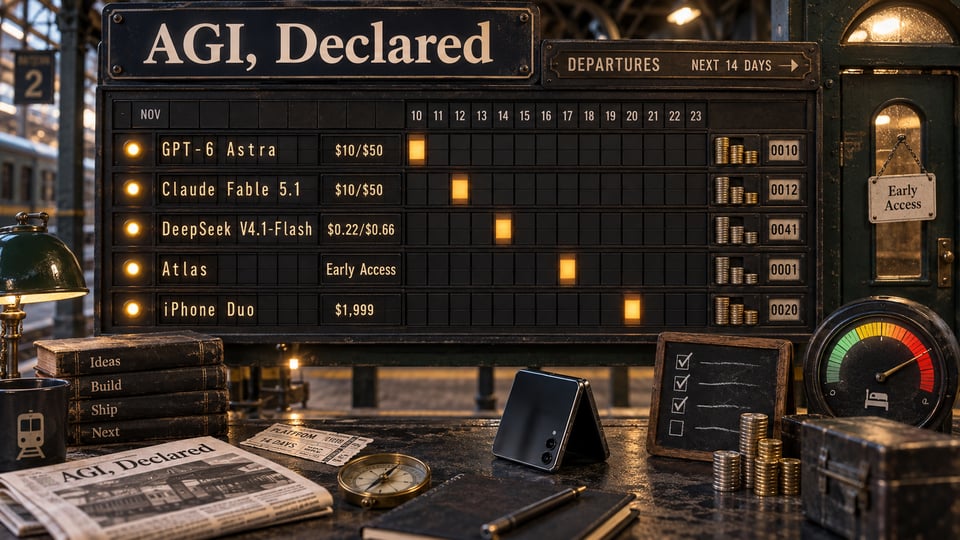
The Two-Week Board
What a practitioner can deploy or act on today:
GPT-6 Astra, OpenAI, September 3: $10/$50 per million tokens, 1,050,000-token context, long-context premium above 272,000 input; cyber-sensitive capabilities behind trusted access; Pro tier paused for capacity [9][12].
Claude Fable 5.1 and Mythos 5.1, Anthropic, September 1: $10/$50 headline, cache reads cut from $1 to $0.25; typical workloads about 25% cheaper, agentic up to 45% [9].
DeepSeek V4.1-Flash, September 10: MIT weights, 552B mixture-of-experts, KV cache cut to a quarter; $0.22 input, $0.007 cached, $0.66 output; off-peak cached at $0.003 [10][6].
Muse Spark 1.3 (Meta, September 2), Qwen3.8-Max-0902 (Alibaba, September 2), Gemini 3.8 Flash and its Cyber variant (Google, same window) [9].
Atlas, World Labs, September 1: the world model, early access only, no pricing, no API date [6].
iPhone Duo, Apple, September 9: first foldable, $1,999, under new CEO John Ternus; the consumer-AI hardware test to watch [6].
Watch: model fatigue as a named condition, with Runpod's CEO on froth and Altman on "faster cadences" [9]; the Navier-Stokes proof awaiting independent scrutiny [1]; Anthropic's Nasdaq preparation [17].
Closing Takeaway
The era was declared before it was measured, the instruments declined to agree, and the fortnight quietly produced everything else: a world model, a fly brain, an open model that attacks memory costs at a thousandth of the price, one lab turning profitable while another stops selling its top tier, $6 billion flowing to companies whose revenue outruns their valuations, and regulators on three continents moving from drafts to door-knocks. That is what an actual AGI-adjacent fortnight looks like: not one story, but a stack of them moving at different speeds. The practitioners who win the next cycle will ask which harness before repeating any score, price cache reads before admiring any benchmark, model capacity before capability, treat the 89% pilot-stall rate as their base rate, and read every ban panic against the documented status of what is actually restricted. AGI may well arrive someday. It will not arrive by press release, and this cycle the skeptic, the evaluator, and the benchmark administrator all said so, in writing, under their own names.
Liked this issue? Forward it to a colleague who needs to stay ahead.
Subscribe to The MediaDataFusion Signal
References
AGI Society. "Evaluating Recent Claims of AGI by NVIDIA CEO Jensen Huang and OpenAI President Greg Brockman." https://agi-society.org/publications/evaluating-agi-claims . Accessed 2026-09-14
ARC Prize (Greg Kamradt). "OpenAI's GPT-6 Astra on ARC-AGI-3." https://arcprize.org/blog/astra . Accessed 2026-09-14
Gary Marcus, Marcus on AI. "Hot take on GPT-6 Astra" and "Sad to see Jensen Huang claim that AGI has arrived, with no evidence and no definitions." https://garymarcus.substack.com/p/hot-take-on-gpt-6-astra . Accessed 2026-09-14
Bank for International Settlements. "BIS Annual Economic Report 2026." https://www.bis.org/publications/aer-2026 . Accessed 2026-09-14
Microsoft. "Open Weights and American AI Leadership." https://www.microsoft.com/en-us/corporate-responsibility/topics/open-weight/ . Accessed 2026-09-14
Stanford Tech Review (Amara Singh). "AI News This Week: GPT-6 Astra, iPhone Duo, $6B in Funding." https://stanfordtechreview.com/articles/ai-news-this-week-gpt-6-astra-iphone-duo-funding . Accessed 2026-09-14
Forkast.News. "OpenAI's Chief Scientist Says No Lab Has Solved Alignment - and Calls for Voluntary Slowdowns." https://forkast.news/openais-chief-scientist-says-no-lab-has-solved-alignment-and-calls-for-voluntary-slowdowns/ . Accessed 2026-09-14
Metir AI. "GPT-6 Astra: OpenAI's Launch, Benchmarks, and the AGI Claim." https://www.metirai.com/blog/openai-gpt-6-astra-launch-agi-cyber-threshold-2026 . Accessed 2026-09-14
StartupFortune (Dave Barr). "Anthropic, OpenAI, Meta and Google All Shipped New AI Models in One Week." https://startupfortune.com/anthropic-openai-meta-and-google-all-shipped-new-ai-models-in-one-week/ . Accessed 2026-09-14
The Decoder (Jonathan Kemper). "New Deepseek model V4.1-Flash cuts memory needs for AI agents." https://the-decoder.com/new-deepseek-model-v4-1-flash-cuts-memory-needs-for-ai-agents/ . Accessed 2026-09-14
Gartner and IDC 2026 data via specialist summaries. "Why Enterprise AI Agents Fail" and "Enterprise AI Agent Stats 2026." https://www.beri.net/article/ai-agent-adoption-enterprise-2026-gartner-idc . Accessed 2026-09-14
Fortune (Mia Osmonbekov). "OpenAI paused its $200 ChatGPT sign-ups as 'unprecedented' demand for Astra strains its system." https://fortune.com/2026/09/11/openai-astra-chatgpt-pro-pause/ . Accessed 2026-09-14
TFTC Newsdesk. "BIS Flags AI Bubble, Circular Financing, and Sovereign Debt as Top Financial Risks." https://www.tftc.io/bis-annual-report-2026-ai-bubble-circular-financing-sovereign-debt . Accessed 2026-09-14
Introl (Madison Kersh). "The $600B AI Infrastructure Buildout: Hyperscaler CapEx, Debt, and Supply Chain Reality." https://introl.com/blog/hyperscaler-capex-600b-ai-infrastructure-debt-financing-2026 . Accessed 2026-09-14
Futurum Group (Nick Patience). "AI Capex 2026: The $690B Infrastructure Sprint." https://futurumgroup.com/insights/ai-capex-2026-the-690b-infrastructure-sprint/ . Accessed 2026-09-14
AI Stock Wire. "AI's circular deals: Nvidia (NVDA) and Microsoft (MSFT)." https://aistockwire.com/blog/ai-circular-deals-nvidia-microsoft-openai-explained . Accessed 2026-09-14
Financial Times as reported by AIWeekly. "Anthropic Tells Investors It Will Be Profitable Q2 With 80%+ Gross Margins, $11.5B Revenue." https://aiweekly.co/alerts/anthropic-tells-investors-it-will-be-profitable-q2-with-80-gross-margins-115b . Accessed 2026-09-14
StartupFortune. "OpenAI's ChatGPT Ads Reach $1 Billion in Revenue in Just 200 Days." https://startupfortune.com/anthropic-openai-meta-and-google-all-shipped-new-ai-models-in-one-week/ . Accessed 2026-09-14
Superframeworks (Ayush Chaturvedi). "Anthropic Is Now the Only Frontier Lab Not Backing Open Weights." https://superframeworks.com/articles/anthropic-open-weights-debate-founder-model-strategy . Accessed 2026-09-14
Digital Applied. "The Open-Weight Letter - and the Sanctions Threat Behind It." https://www.digitalapplied.com/blog/open-weight-letter-sanctions-procurement-risk-2026 . Accessed 2026-09-14
Semiconductors Insight. "US-China Chip Export Controls in 2026: The Rules Changed, and Nobody Won." https://semiconductorsinsight.com/us-china-chip-export-controls-h200-2026/ . Accessed 2026-09-14
winzheng; ADVISORI. "EU AI Enforcement Officially Opens Fire" and "EU AI Act GPAI Enforcement: Audits & Fines 2026." https://www.winzheng.com/en/article/eu-ai-act-enforcement-september-2026-high-risk-audit . Accessed 2026-09-14
Cubbbix. "AI Regulation News September 2026: Global Enforcement Waves, State Compliance." https://cubbbix.com/blog/ai-regulation-september-2026-global-update/ . Accessed 2026-09-14
RunAI Home. "Local AI and the Right to Compute in 2026: What State Legislation Actually Says." https://runaihome.com/blog/local-ai-right-to-compute-legislation-2026/ . Accessed 2026-09-14